Vacuum Bag Sealers: What the Extra Packaging Step Actually Returns
Adding an evacuation step costs a station, a cycle and compressed air. It earns back shelf life, freight density and fewer rejected batches — if the product justifies it.
Evacuation removes the oxygen and moisture that drive caking, oxidation and microbial growth.
Removing air also compacts the bag, cutting warehouse and freight volume per tonne.
Extraction rate has to be controlled or fines are carried out with the air.
Seal quality depends on keeping product out of the seal area.
The business case rests on product value, storage time and transport distance.
Technical Overview
What the evacuation step does
A vacuum heat sealing machine adds one operation to a bagging line: after filling, the bag mouth is clamped, air is drawn out through a nozzle or chamber, and the mouth is heat sealed while still under vacuum. The product then sits in a package with very little oxygen and very little water vapour. For powders that cake, oxidise or support microbial growth, that change is the point of the exercise. It is not decoration, and it does not help products that are indifferent to both.
Oxygen, moisture and shelf life
Oxygen and moisture are the two variables that determine how long a powder keeps its specification. Oxidation degrades fats, aromas, colourants and some actives. Absorbed moisture drives caking, hardening and, in food products, mould growth. Removing most of the headspace air attacks both at once. This is the direct benefit, and for products shipped long distances or stored for months it is usually the reason the equipment was bought.
Volume reduction and freight
Removing air from a filled bag compacts the product. The bag becomes firm and square, it uses its full intended volume, and pallets stack higher and more stably. Over a container load, that reduction translates directly into freight and warehouse cost per tonne shipped. For low-density powders where transport cost is a significant share of delivered cost, this line in the calculation can be larger than the labour saving from automating the closing step.
Controlling the extraction rate
The one process risk specific to fine powder is entrainment. Pull air out too fast and product follows it into the extraction line, where it fouls filters and is lost. The practical solutions are staged or pulsed evacuation rather than a single hard pull, a filter in the extraction path sized to capture the fines, and in some designs a short blow of clean air across the bag mouth to clear residual powder before the jaws close. Machines built for ultra-fine product sometimes invert the sequence — partially seal, evacuate through a small port, then close the port.
Seal integrity
A vacuum seal is only as good as the contact surface. Product in the seal area is the most common cause of a leak: the powder sits between the film layers and prevents fusion. Cleaning the bag mouth before sealing, by air knife or brush, is a cheap and effective measure. Temperature, dwell time and jaw pressure have to be matched to the film specification — the heat-seal layer, its thickness and the supplier's data. Where the product is genuinely difficult, dual sealing bars give redundancy on a critical closure.
Where the payback comes from
The case is strongest for high-value powders, long storage or shipping distances, and products with a history of moisture or oxidation complaints. For a cheap filler consumed within days and trucked a short distance, evacuation is unlikely to earn its keep. The honest method is to list the cost lines — rejections, returns, freight, warehouse space, cleaning labour — and see which ones the evacuation step actually removes. In our experience the recovered-product line is the one most often overlooked, and sometimes the largest.
Integration with the packing line
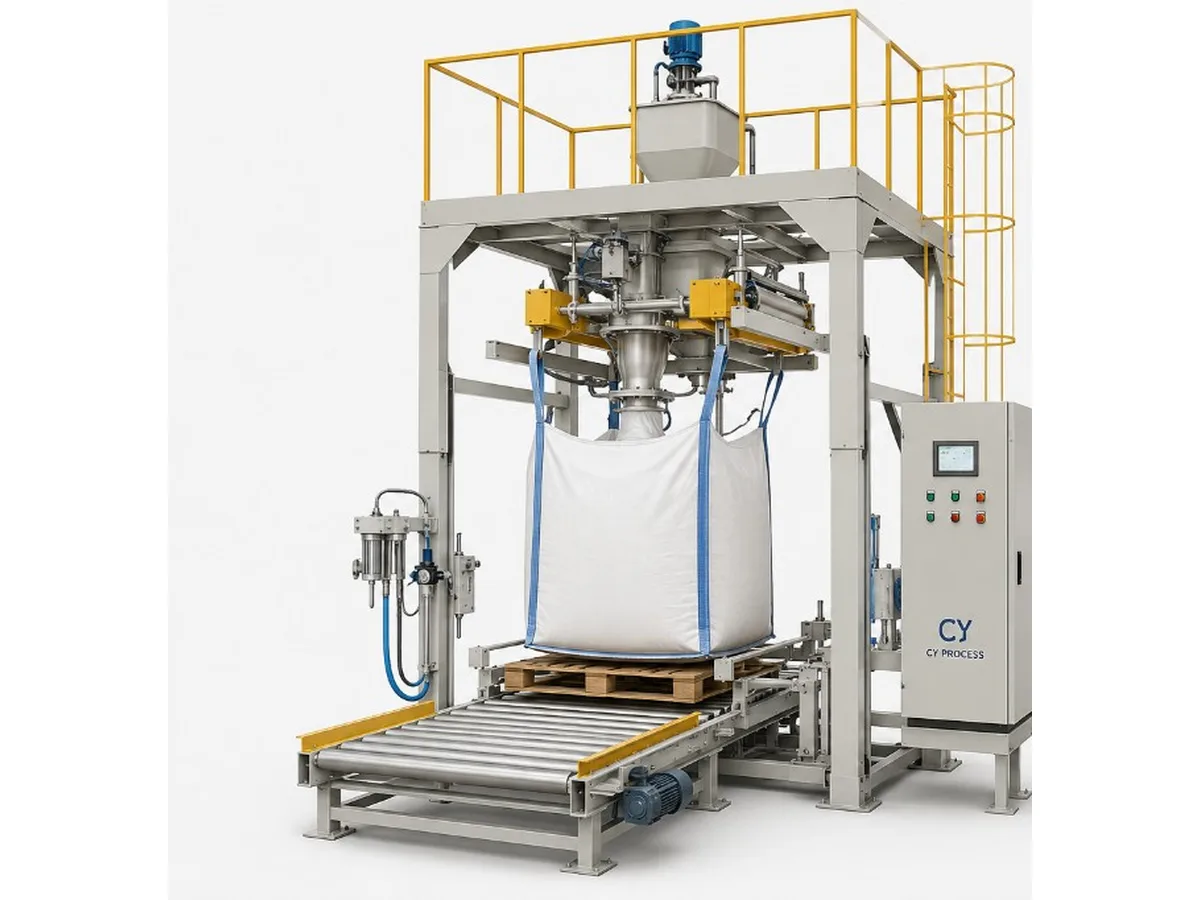
The sealer sits after the filler and before checkweighing and palletising, and its cycle time has to match the filler's. Automated bag placement and discharge, and the option of linking to the filler's control system, keep the station from becoming the bottleneck. On fine powders the evacuation stage needs its own dust collection; ignoring this is a common cause of housekeeping complaints around an otherwise well-designed packing line.
Safety and specification
Where the product is combustible, the sealing station needs the same treatment as the rest of the line: earthing and bonding, dust extraction at the evacuation point, and components rated for the zone. Heat-sealing elements add an ignition source that has to be considered in the assessment. For the enquiry, state the product, its particle size, bulk density and moisture; the bag material and construction; the target weight; the throughput; and the hygiene class and hazardous-area classification. CHUYAO supplies vacuum sealing as part of the complete packing line and proves the cycle at start-up.
Process Flow
Typical steps covered in this article.
Bag Placement
Mouth Clamping
Controlled Evacuation
Heat Seal
Cool & Discharge
Typical Applications
Moisture-sensitive food powders
Battery electrode materials sensitive to oxidation