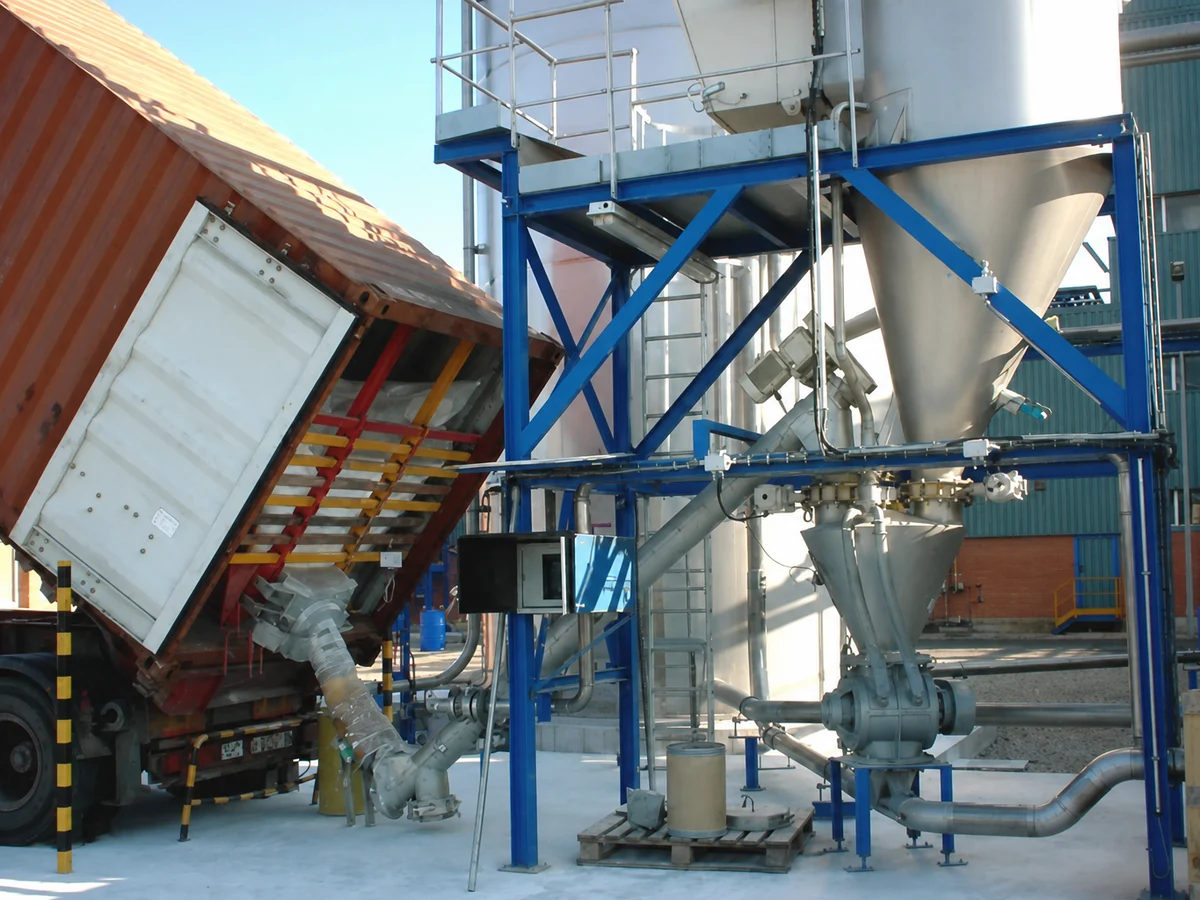
Automation encloses the whole unpacking sequence instead of filtering after the fact.
Food and pharmaceutical plants gain hygiene and allergen control as well as dust reduction.
Battery material plants gain containment on high-value, oxidation-sensitive powders.
Residue left in the bag is a product loss that automation recovers.
Material testing before specification is essential because flow behaviour varies enormously.
Technical Overview
What an automatic unpacker does
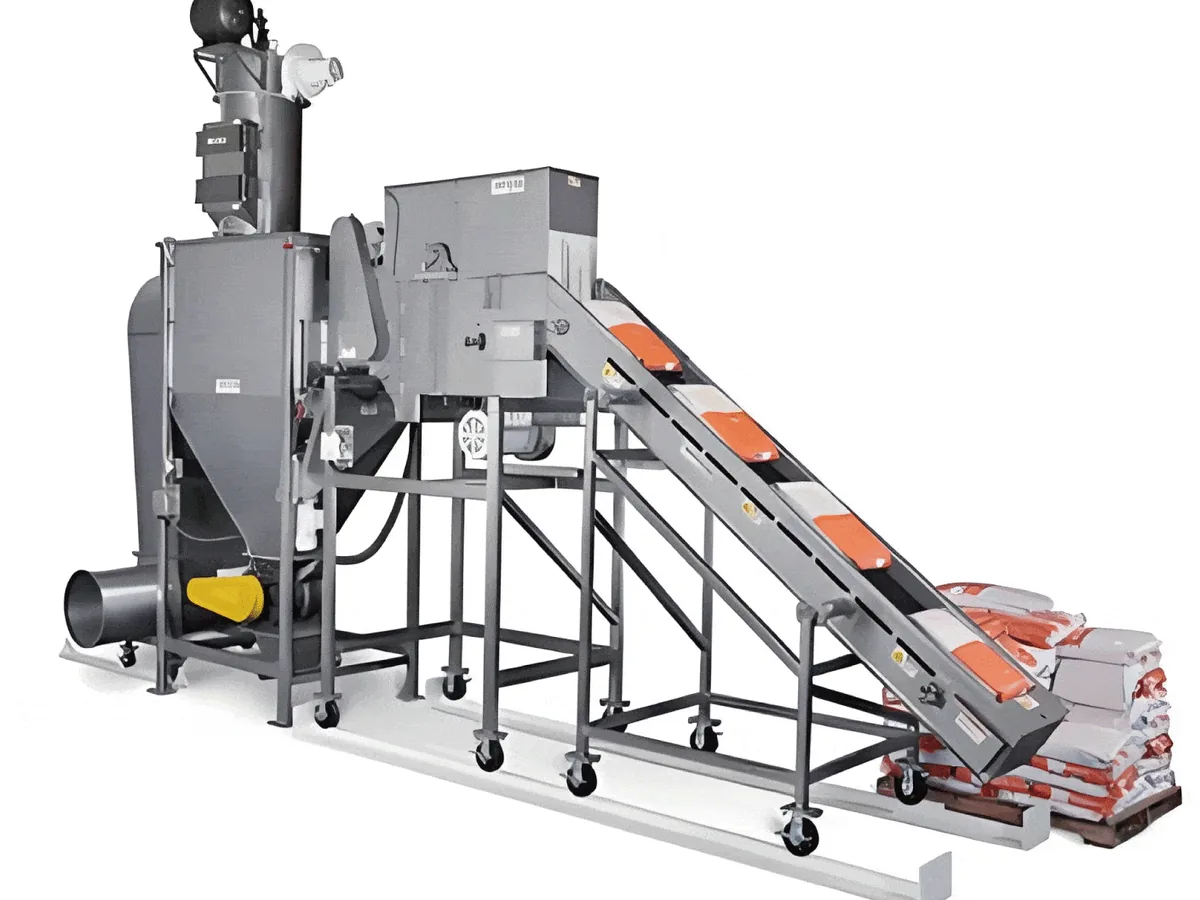
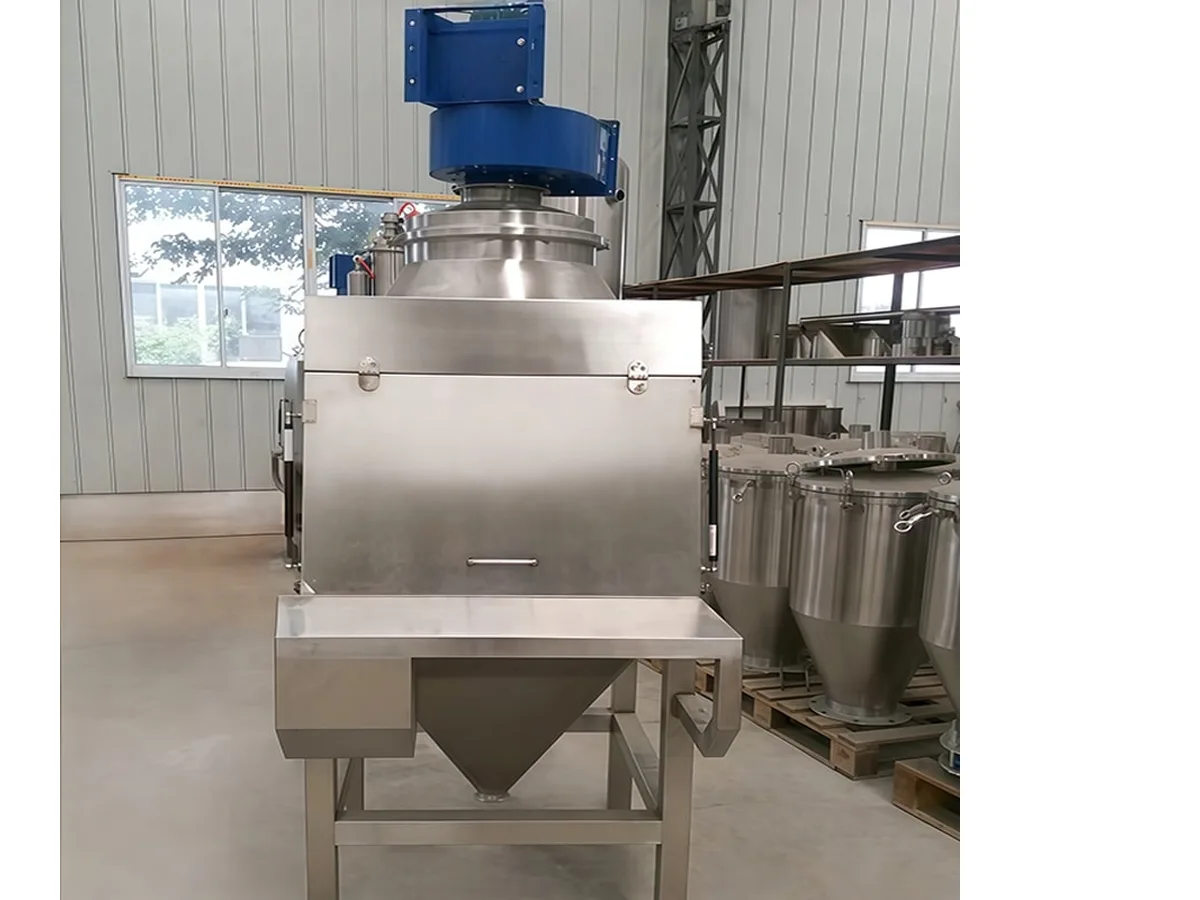
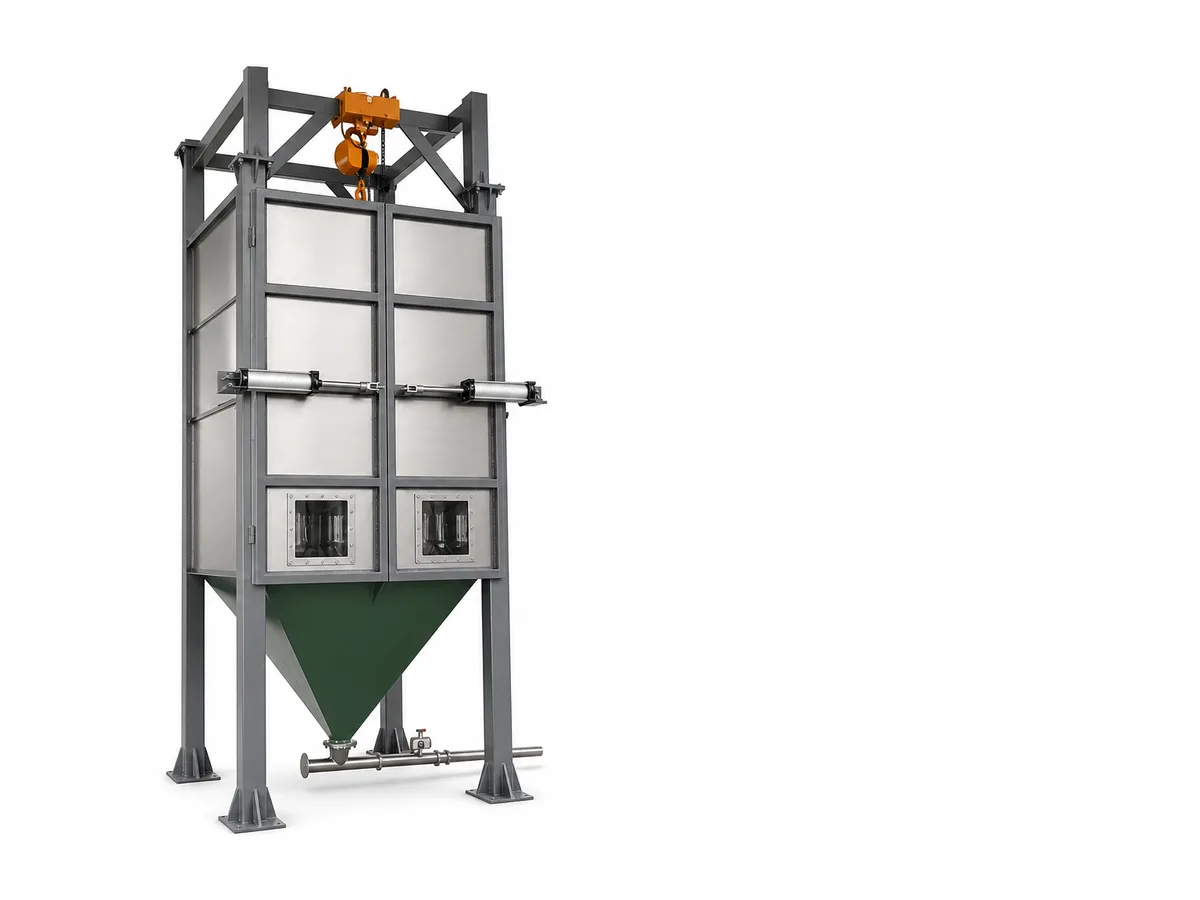
An automatic bag unpacking machine takes a filled sack from a conveyor, presents it to a cutting device inside an enclosure, opens it, discharges the contents through a screen or hopper, separates and compacts the empty bag, and collects the dust generated throughout. The whole sequence happens inside a closed housing held under negative pressure. The operator's role reduces to loading the infeed; they no longer stand over an open sack with a knife.
Why food and dairy plants adopt it first
In food work the drivers are hygiene and allergen control as much as dust. Enclosing the task stops airborne powder from settling on surfaces that will later contact a different product, and it keeps the operator's hands out of the material. Cleaning is simpler too, because a sealed chamber with smooth internal surfaces can be washed down predictably, whereas an open tipping station spreads product across the surrounding floor and equipment. For plants running multiple formulations, that difference shows up in changeover time.
Battery and advanced materials
Battery electrode powders are both high-value and sensitive. Cathode and anode materials lose performance if they pick up moisture or oxidise, and several are handled under inert gas or in dry rooms. Enclosed unpacking with dust-tight collection recovers powder that manual handling loses, and it keeps the workspace within the limits the process requires. Where the product is also combustible, the unpacker's earthing, extraction and component ratings become part of the hazard assessment rather than an afterthought.
Residue, yield and the hidden cost
Manual shake-out leaves material in bag corners and folds, and that residue is a direct product loss. Automated systems with vibrating discharge and mechanical wipe-down reduce it substantially. Over a production year on an expensive powder, recovered material frequently outweighs the labour saved — and it is the line item most often missing from the original business case, because it does not appear as a cost anywhere today.
Hygiene and cleaning design
For food and pharmaceutical duty the machine has to be cleanable, not merely enclosed. Product-contact parts in 304 or 316L stainless, continuous smooth welds, rounded internal corners, no ledges or crevices, and tool-free access to the cutting zone and screen are what make routine cleaning realistic. Where allergen control applies, the clean-down procedure has to be validated, and that is far easier on a machine designed for it from the start.
Dust control sized for the real event
Unpacking generates dust in bursts: when the bag is cut, when it discharges, and when the empty is ejected. Extraction has to be sized for the peak, with pickup points at each burst location rather than a single port in the housing. Filter media selection follows the particle size, and the cleaning regime has to keep up without fluidising the collected powder back into the airstream. Systems that under-extract do not fail gradually — they fail visibly, on the floor around the machine.
Specifying the station
State the product, bulk density, particle size, moisture and flow behaviour; the bag material, size and closure; the required throughput in bags per hour; the receiving equipment; and the hygiene class and hazardous-area classification. Ask for a trial with your own bags and product, because the way a particular powder flows out of a particular sack is not reliably predictable from a datasheet. CHUYAO configures the unpacker together with the downstream conveying and dosing equipment, so the discharge interface, screen and extraction are settled as one assembly and demonstrated at start-up.
Cleaning, allergen control and traceability
For food and pharmaceutical duty the machine has to be cleanable in practice, not only in principle. Product-contact parts in 304 or 316L stainless, continuous smooth welds, coved internal corners and tool-free removal of the cutting and screening elements make a validated clean-down realistic. Where allergens are handled, the clean-down procedure between products matters as much as the enclosure itself. Automated unpacking also produces a usable record — bags in, product out, lot identity — which is increasingly what the quality system is expected to show, and which manual knife work cannot provide.