Open-Mouth Bag Fillers: Chasing Weight Drift and Dust at the Spout
Two complaints dominate open-mouth bagging: the weights wander through the shift, and there is dust around the spout. Both usually trace back to feed behaviour rather than the weighing.
Open-mouth bags accept almost any product, including cohesive, lumpy or fragile ones.
Weight drift usually comes from bulk density change, feed instability or in-flight compensation being out of date.
Dust at the spout means displaced air is not being extracted, not that the bag is faulty.
Seal failures are usually product in the seal area, or wrong temperature, time or film.
Aerated powder needs de-aeration before closing or bags will be soft and unstable on the pallet.
Technical Overview
Why open-mouth and not valve
The open-mouth format exists because it is the most tolerant bag in the plant. Valve bags fill fast and seal tightly with no separate closing step, but they demand a free-flowing or fluidisable product. Open-mouth bags accept cohesive, lumpy, fibrous or fragile materials and almost any bag material, including PE liners, at the cost of lower speed and a separate closing station. That trade is the right one whenever the product will not flow reliably through a small valve.
Weight drift between shifts
When bag weights move during the day, work through three candidates. First, bulk density: a new lot, a humidity change, or aeration from filling can shift the mass delivered per revolution, and a machine calibrated in the morning will not know. Second, feed instability: bridging in the supply hopper, a screw that floods, or a supply level that drops too far all change the delivered mass between the coarse and fine phases. Third, in-flight compensation: the material still in the air when the valve closes counts toward the bag, and that figure has to be tuned per product. Daily test weights and a checkweigher with feedback catch all three before they leave the plant.
Dust around the spout
Dust at the filling point is almost always displaced air. Powder entering the bag pushes out an equal volume of air, and that air picks up fines on the way. The remedies are a hooded spout with extraction at the point of fill, an inflatable seal that closes the gap between bag and spout, dust-tight bag construction, and extraction capacity sized for the displaced volume rather than the product flow. A blocked extraction filter will undo all of it, which is why filter differential pressure belongs on the daily check.
Weighing architecture
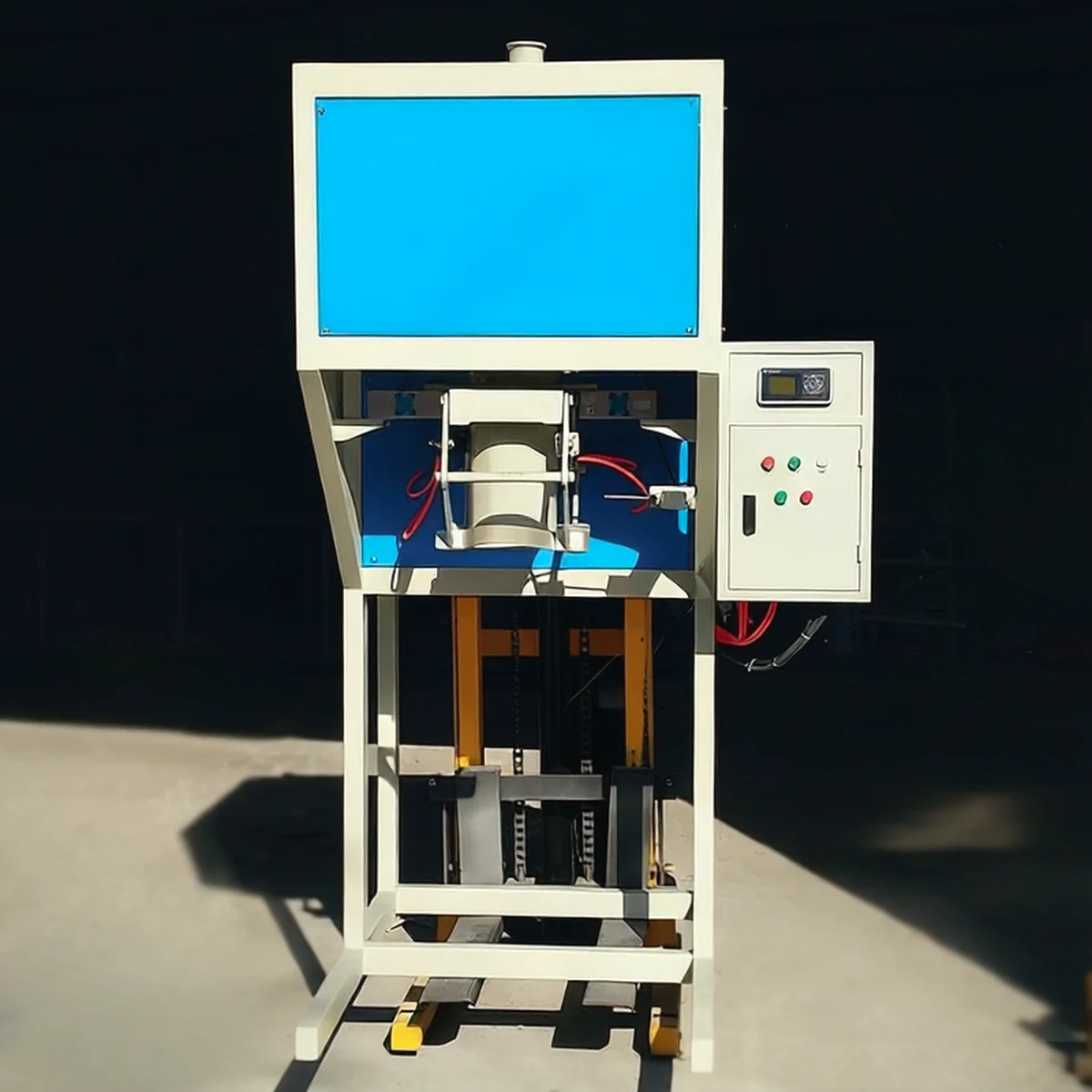
Net weighing in the bag is the common arrangement for open-mouth machines: the bag is clamped to the spout, filled on the platform's load cells, and the controller switches from coarse to fine feed as the target approaches. The mechanical requirement is that nothing but the bag and its contents bears on the cells — the fill head, the closing equipment and any guard have to be isolated. Vibration transmitted from the building or from adjacent machinery shows up as instability and has to be dealt with mechanically before it is filtered electronically.
Fill behaviour and de-aeration
Fine, aerated powders behave like a fluid when they first enter the bag and settle over the following minutes. If the bag is closed immediately, it arrives at the palletiser soft, oversized and unstable. De-aeration before closing — a probe, vacuum, or vibration during the fill — lets the product settle so the bag fills its intended volume and holds a square shape. It also improves the seal, because there is less airborne dust in the seal area at the moment of closing.
Seal and closure faults
When closures fail, the cause is usually contamination or a parameter, not the machine. Product left in the seal area prevents fusion; cleaning the bag mouth with an air knife or brush before sealing is a cheap and effective fix. Temperature, dwell time and pressure have to suit the film specification — heat-sealable layer, thickness and supplier. Where sewn closures are used, check thread tension and needle condition, and for dusty products consider a tape or inner liner to close the needle holes.
Routine that prevents the drift
Daily: verify a test weight on a certified checkweigher, check the extraction filter differential pressure, confirm clean bag mouths at the seal. Weekly: inspect the clamp and spout seal for wear, check feeder hopper level control and any anti-bridging device. Monthly: calibrate the weighing system against traceable test weights and review reject trends from the checkweigher. Keeping a simple log of weights, rejects and filter readings is what turns a recurring complaint into a traceable correction.