Shaftless Screw Conveyors: The Standard Answer for Sticky, Fibrous and Cake-Like Material
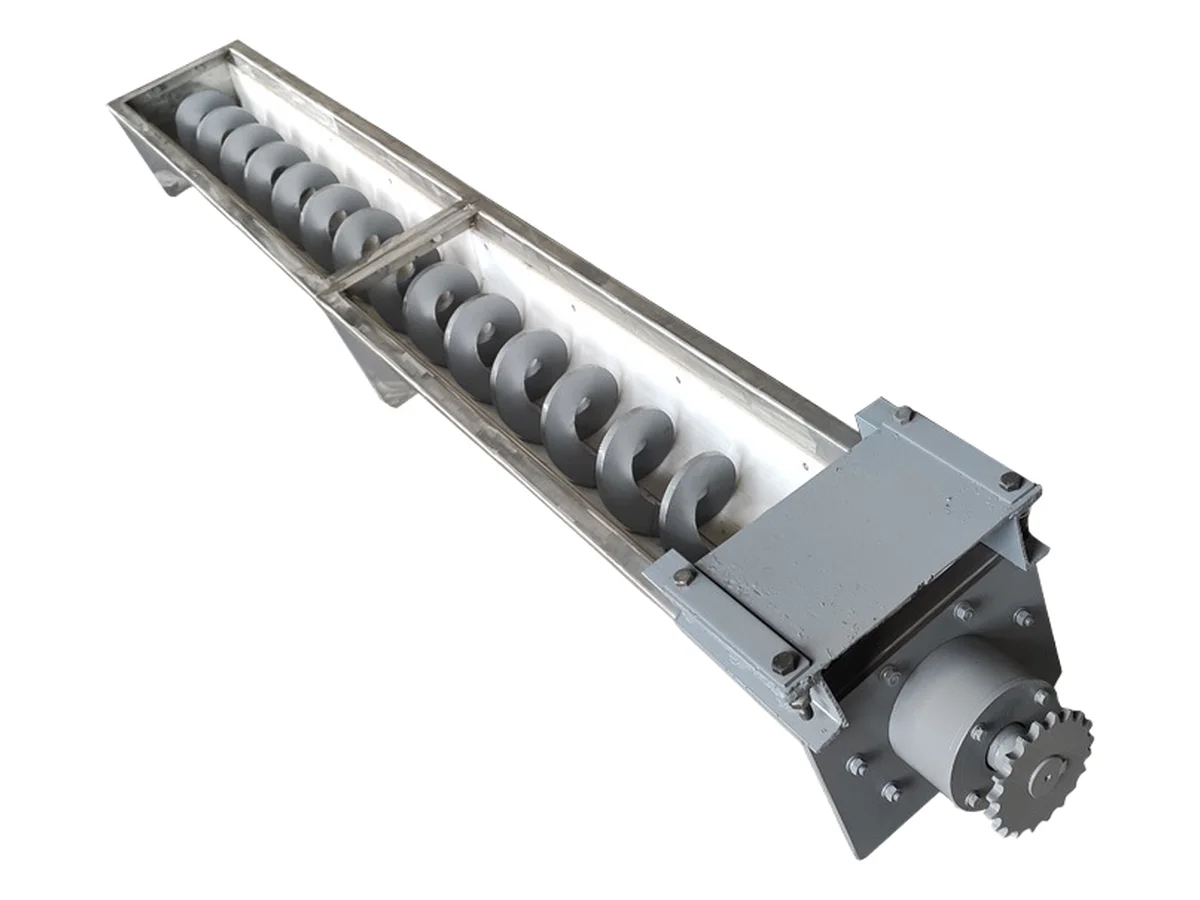
The shaftless spiral is not a screw conveyor with the shaft removed. Removing the centre pipe changes what the machine can carry and what it cannot do at all.
With no centre shaft there is no surface for sticky or fibrous material to wrap around.
No intermediate hanger bearings removes the dominant wear and failure point in wet service.
Fill rates can be substantially higher than an equivalent shafted screw.
The open helix rides on a replaceable trough liner that also provides the self-clearing action.
Very long single runs are possible because hanger bearing spacing no longer limits section length.
Technical Overview
What removing the shaft changes
A conventional screw conveyor welds helical flighting to a centre pipe, and that pipe is supported every few metres by hanger bearings. It is a good arrangement for free-flowing material and a poor one for anything wet, sticky or fibrous. Product packs between the flight and the shaft, wraps around the pipe, and fills the hanger bearing housings — the machine slowly chokes, torque rises, and the drive trips. A shaftless spiral removes all three failure surfaces at once: no centre pipe to wrap around, no shaft-to-flight corner to pack, and no intermediate bearings to fill.
How the shaftless spiral works
The conveying element is a continuous helix of heavy flat bar or round section, formed with no central axis. It sits directly on a replaceable liner in the bottom of a U-shaped or round-bottom trough, usually UHMWPE or a wear-resistant equivalent. As the helix rotates it drags material along the trough floor; the open core means there is nothing in the middle for material to catch on. Drive is typically direct-coupled to a shaft-mounted or helical-bevel gear reducer, with no belts or chains. The helix is thicker and heavier than a shafted flight, and because there are no hanger bearings, a single section can be much longer.
Capacity advantages
Two things raise the throughput of a shaftless spiral relative to the same diameter of shafted screw. The obvious one is the absence of the centre pipe: the full open area of the helix is available for material, rather than having a shaft's volume deducted. The less obvious one is fill rate. Because there is no shaft for product to pack against and no hanger bearings to obstruct it, cohesive materials can be carried at a higher fill than a shafted screw would tolerate. The combination is why a shaftless unit of a given diameter can move substantially more of a difficult product.
What it carries well
The shaftless design is the usual specification for dewatered sludge cake, wastewater screenings, paper and pulp waste, fibrous biomass and food waste, adhesive chemical residues and wet filter cake, and products with irregular or large lump sizes. Practically, the pattern is simple: if the material wraps, smears or packs, or if it comes in lumps too large for a shafted flight's clearance, the shaftless spiral is the candidate.
Incline and configuration
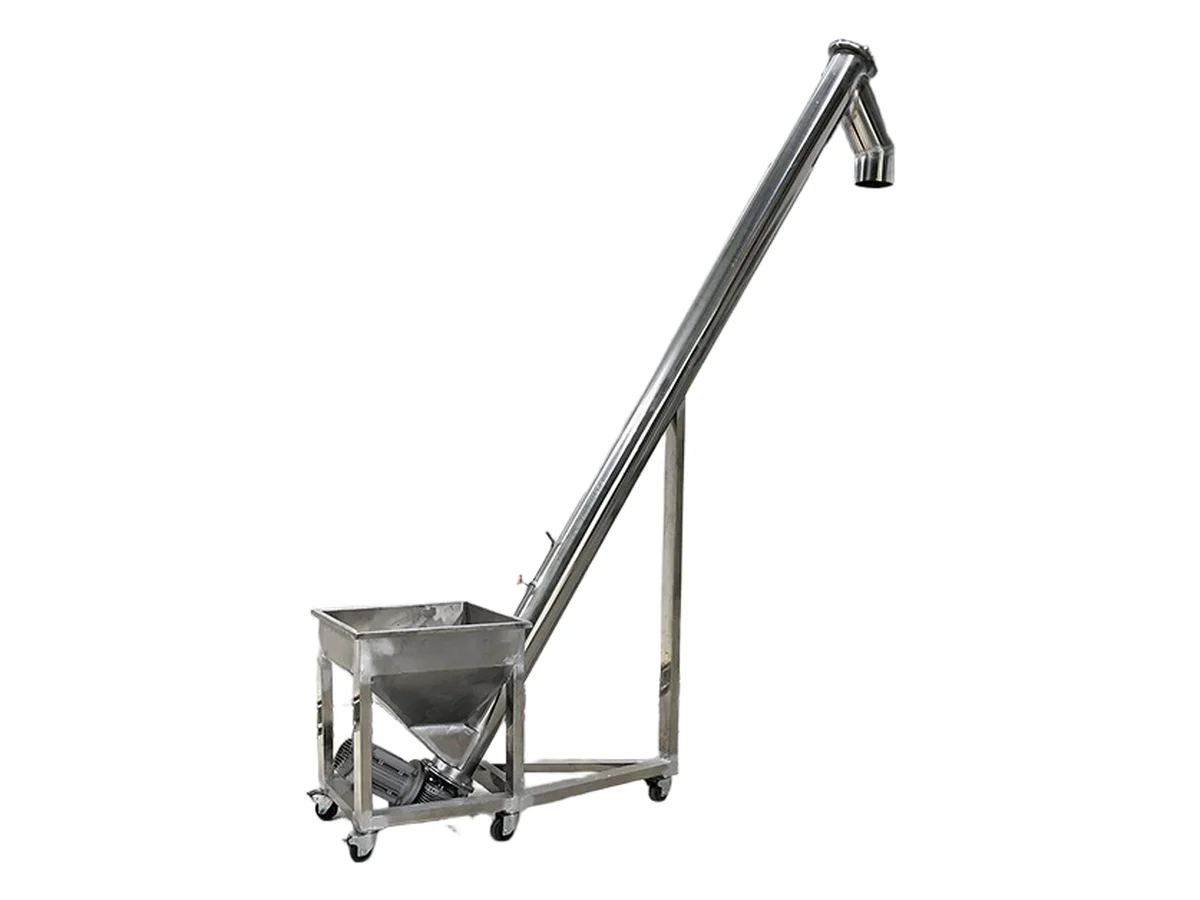
Shaftless spirals are built for horizontal and inclined duty, with typical recommendations keeping the incline below about 30 degrees for sticky materials — beyond that, rollback becomes significant and capacity falls away. Troughs are fully enclosed, which matters for odour containment as well as dust. Sections can be coupled for longer routes with drives arranged at each section. Liner material is chosen against the product: UHMW for low friction and self-clearing, AR steel or ceramic where abrasion dominates.
Maintenance is simpler, not absent
With the hanger bearings gone, routine work concentrates on the drive and the trough liner. Liners wear and are replaced in sections without removing the spiral — that is the design intent, and it is worth confirming the liner is segmented before ordering. Drive gearboxes need the usual oil checks. Inspection should include measuring liner wear and checking that the helix has not deformed, since a bent spiral will contact the liner and accelerate wear dramatically.
Enquiry essentials
State the material and its moisture content, bulk density, stickiness and particle size; the required throughput; the route including length, incline and number of discharge points; the trough and liner material required; and the environment including wash-down and hazardous-area classification. CHUYAO configures the helix section, pitch and liner to the duty and validates at commissioning, because a shaftless spiral that is correctly matched to a difficult product will run for years where a shafted machine would not survive a season.