Fall protection is a design requirement, not an add-on — guardrails at protected edges come first.
Toeboards prevent objects falling onto people and walkways below.
Design for real loads: vessel weight, full product, maintenance loads and dynamic forces.
Vibration from mixers and vibrators has to be accounted for in the frame, not absorbed by the vessel.
Access for cleaning, filter changes and removal routes should drive the layout.
Technical Overview
Fall protection belongs in the drawing
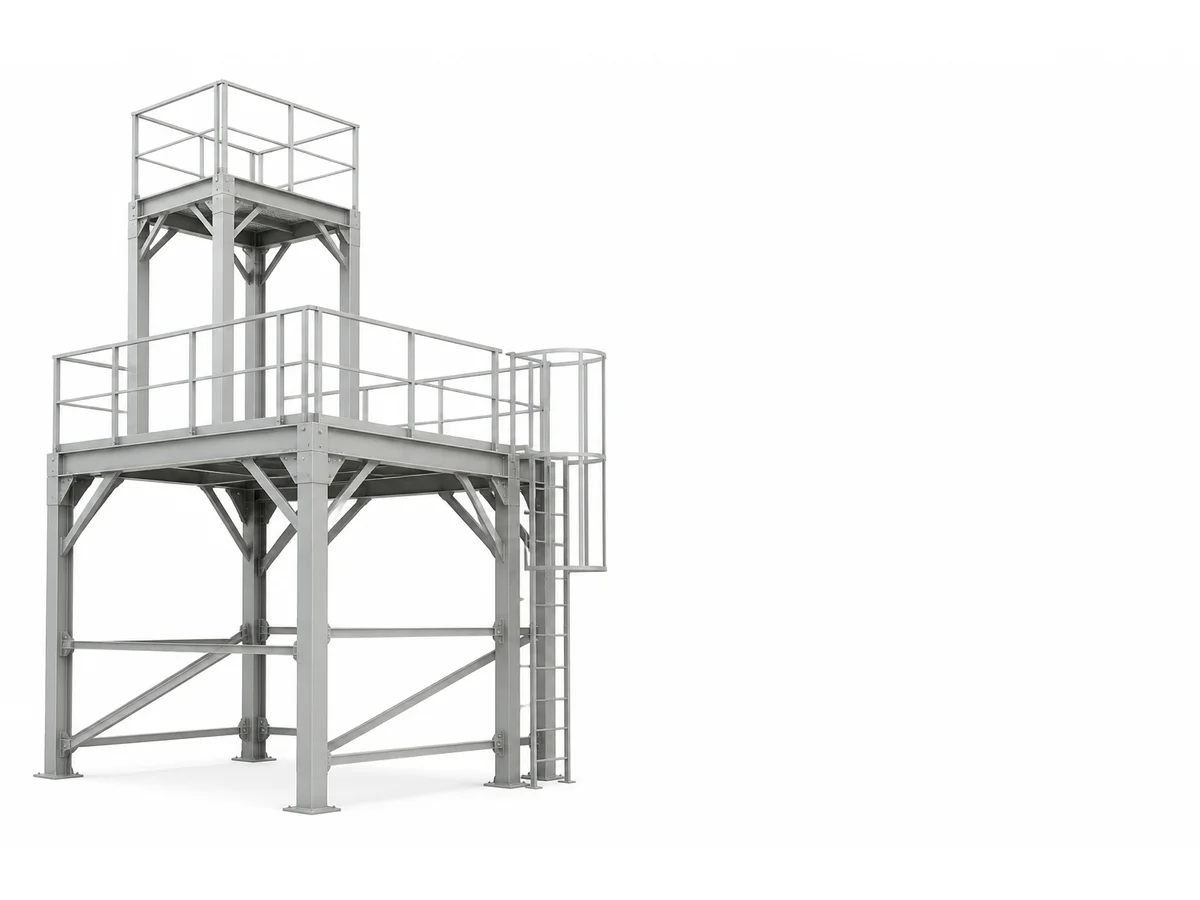
Any walking or working surface with an unprotected edge above the relevant trigger height needs fall protection, and passive protection is the preferred answer. Guardrails protect everyone in the area continuously, need no training and do not depend on individual behaviour. The standard arrangement is a top rail around 42 inches above the walking surface, an intermediate rail, and posts at a defined maximum spacing. The system has to be built to withstand a specified horizontal force applied at the rail, which is a fabrication requirement rather than a guideline. Where guardrails are genuinely infeasible, the alternative is a documented falling-object and fall-arrest solution — not simply leaving the edge open.
Toeboards and dropped objects
The bottom of an open edge needs a toeboard or kick plate of adequate height, fitted with a minimal gap to the deck. It stops tools, spares, fasteners and product from rolling off the edge onto people below. In powder plants the housekeeping case is equally strong: material kicked over an edge becomes fugitive dust, which then becomes both a cleaning problem and, with combustible products, a secondary explosion hazard.
Loads: more than the vessel
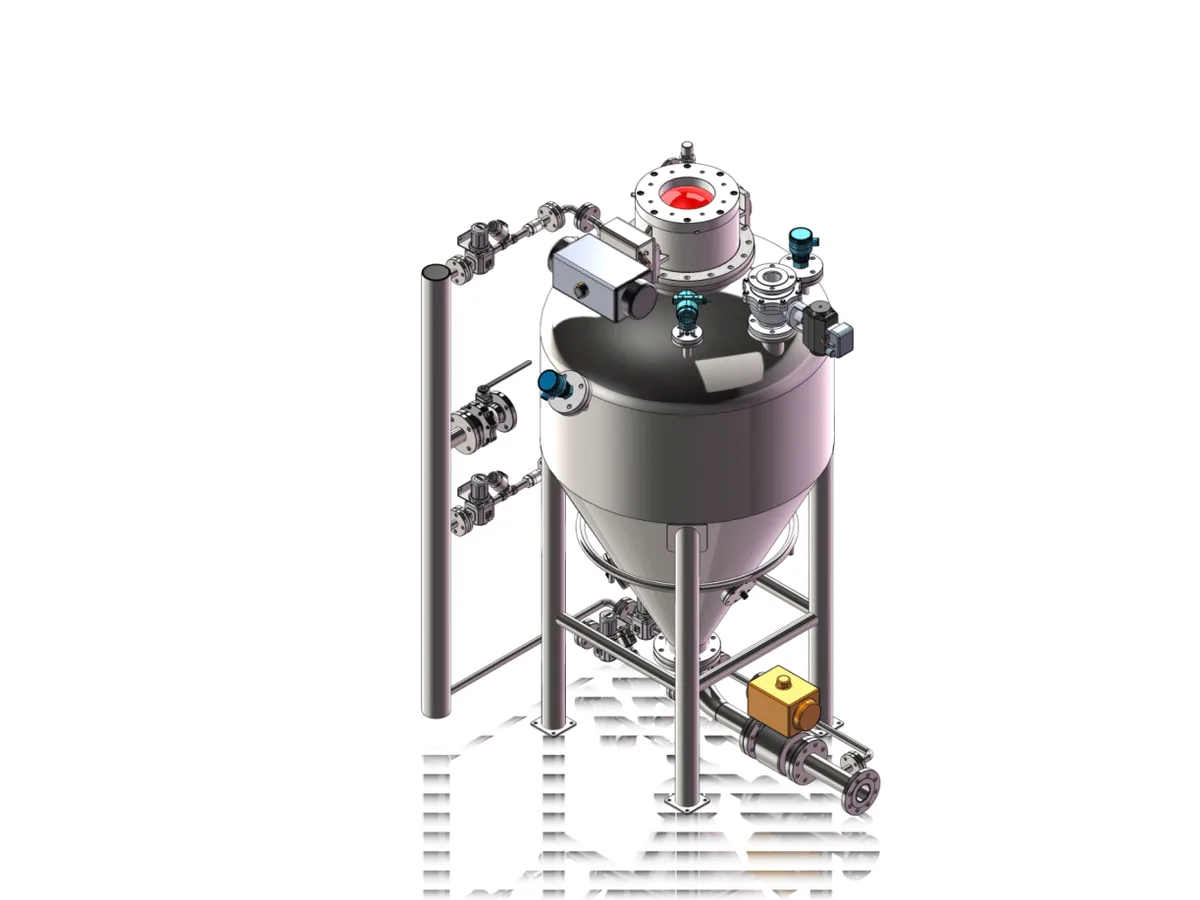
Platform design has to account for the dead load of the vessel and structure, the live load of the full product, and the imposed loads from operation and maintenance — an operator with tools, a removed filter element, a motor awaiting refitting. Add dynamic effects: agitator reaction, discharge impulses, and the vibration transmitted from mounted equipment. Tall or slender vessels outdoors bring wind and seismic loading, and lateral loads should be carried by the base frame through guides or check rods rather than through the structure supporting the vessel.
Vibration isolation
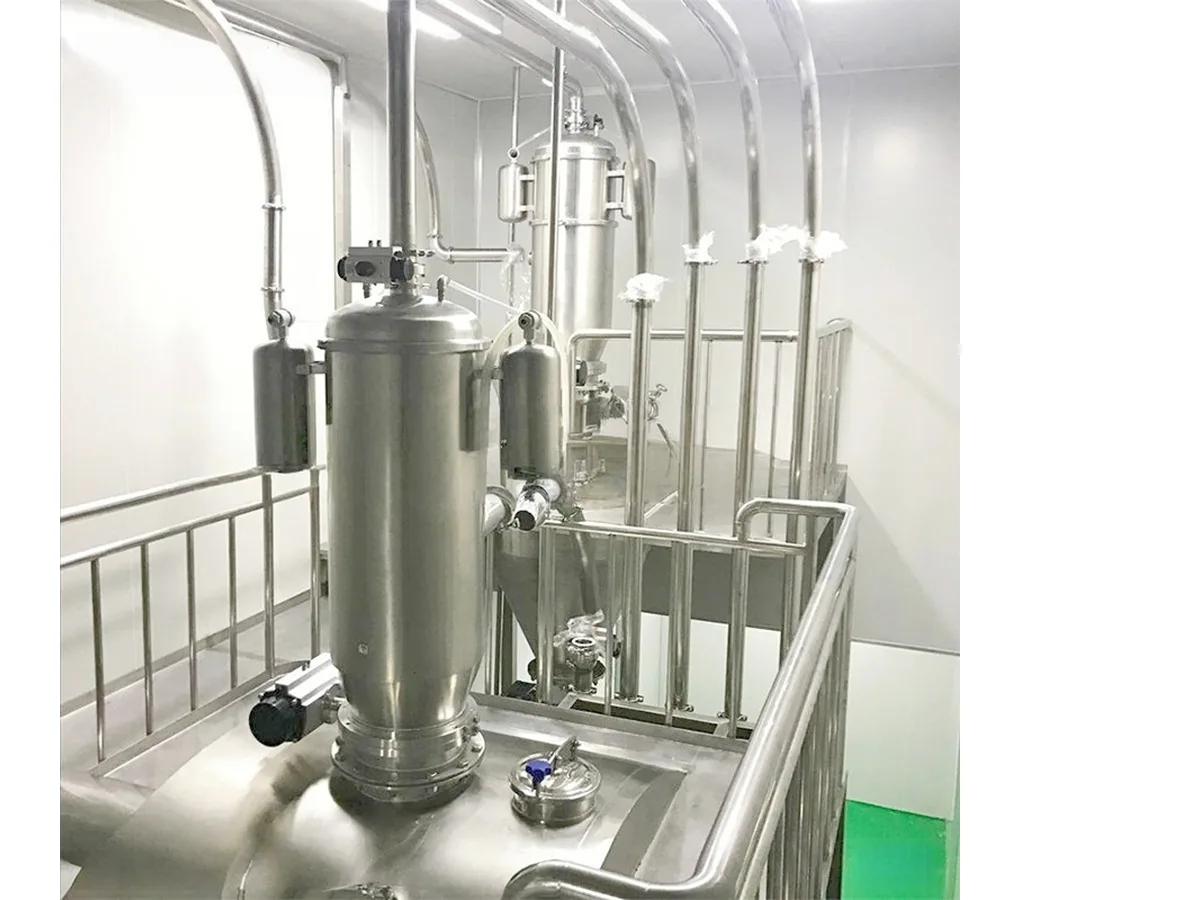
Powder plants are full of intentional vibration — vibrators, oscillators, screens — and a frame that ignores it transmits noise into the building and into any weighing equipment mounted nearby. Isolation mounts between the vessel and its frame reduce transmission, and the frame itself needs enough stiffness that it does not amplify rather than attenuate. Where weighing instruments share the structure, isolation is not optional: it is the difference between a stable reading and one that cannot be trusted.
Surfaces, drainage and hygiene
Decking choice follows the duty. Bar grating drains and is light; chequered plate gives solid footing; FRP grating suits corrosive environments. In food and pharmaceutical areas, surfaces should be smooth, coved at junctions, drainable and free of ledges and crevices where product can collect. Wash-down duty means the frame detailing, fixings and coatings have to tolerate the cleaning regime for the life of the installation, not just at handover.
Inspection and maintenance access
Design the platform around what has to be done on it: filter changes, screen deck removal, motor replacement, cleaning. That means clearance for the largest component to come out, a route for it to leave, and a safe place for the person doing the work to stand. Where access is via a fixed ladder, a self-closing gate at the top opening prevents a backward step into the void. Inspection of welds, fixings and coatings should be part of a fixed regime, with findings recorded so a trend is visible.
Enquiry information
Provide the vessel dimensions, weights and connection positions; the products handled, including density and flow behaviour; the maintenance tasks and frequency; the environment including hygiene class, wash-down and hazardous-area classification; and the building constraints — available floor area, headroom, column positions and floor loading. CHUYAO designs the support frame and access platform together with the equipment it carries, so guarding, loading and service access are resolved in the drawing rather than on site.
Stairs, handrails and gates
Fixed stairs are preferred over ladders wherever a platform is used routinely. Standard stair geometry is around 30 to 50 degrees pitch, with handrails on stairways and landings sized to the stair width. Ladders suit low-traffic or space-constrained positions; a vertical climb above roughly 20 feet generally needs a cage or fall-arrest provision, and ship or alternating-tread ladders save space at the cost of a steeper climb. Wherever a ladder or stair meets an open platform edge, a self-closing gate — spring-loaded is preferable, since it closes without anyone remembering to — prevents a backward step into the opening.