How a Ribbon Blender Mixes: The Counter-Flowing Helix Explained
A ribbon mixer has no high-speed impeller. It works by moving the whole batch against itself along two opposing axial paths — which is why fill level and clearance matter more than speed.
Inner and outer ribbons push material in opposite axial directions, creating continuous circulation.
Mixing is convective, not high-shear — that is what protects friable particles.
Fill level has a working window; under- and over-filling both degrade blend uniformity.
Wall clearance controls dead zones and clean-out, and has to account for wear and deflection.
Segregation after mixing is usually a discharge and transfer problem, not a mixer problem.
Technical Overview
The mechanism: two helices, two directions
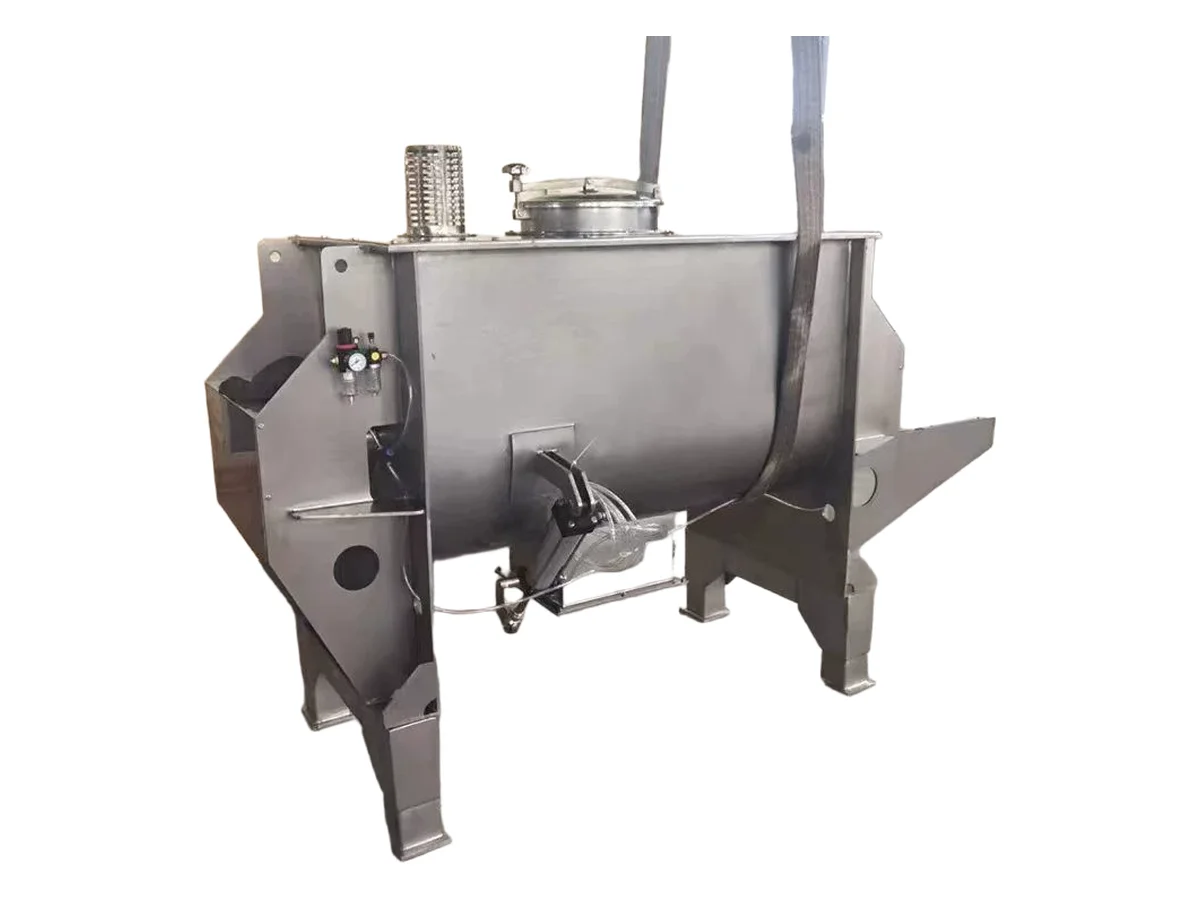
A horizontal ribbon mixer is built around a U-shaped trough with a central shaft carrying two helical ribbons of different diameters. As the shaft turns, the outer ribbon sweeps material along the trough wall in one axial direction while the inner ribbon drives it back in the other. Material is simultaneously lifted and folded across the vessel cross-section as it follows the trough curvature. The result is a three-dimensional convective circulation that exchanges material layers continuously, which is how trace ingredients disperse through a bulk matrix without high-speed impact.
Why convective mixing is gentle
This matters for friable products. High-intensity mixers break particles by impact and shear; a ribbon agitator does its work by bulk movement, so crystals, granules, agglomerates and food inclusions survive largely intact. It also means the machine does not rely on a high tip speed to work, which keeps power demand moderate. The trade-off is that it will not de-agglomerate a hard cake — that is a job for a lump breaker or a mill upstream, not for the blender.
Ribbon geometry is not a detail
Diameter, pitch, ribbon width, axial overlap and wall clearance together determine how effectively the agitator sweeps and turns over the batch. A larger ribbon diameter increases the swept area but also raises torque demand and changes the wall clearance. Pitch sets the axial transport rate: too aggressive and material travels the length without enough cross-mixing, too gentle and cycle time stretches. Clearance is the tightrope: close enough to scrape the wall and avoid stagnant zones, far enough to tolerate thermal expansion, shaft deflection, fabrication tolerance and abrasive wear. Ribbon and paddle combinations suit pasty or fibrous products; fragile materials need geometry that minimises compression and shear.
Fill level has a working window
Ribbon mixers perform within an intended fill band rather than at any level. Typical working volume is roughly 40–70% of vessel capacity, leaving headroom for the bed to expand and circulate. Underfilling starves the circulation and lengthens mixing time; overfilling restricts top-to-bottom turnover and creates dead zones. In practice this means sizing the machine to the batches you actually run. A mixer bought for future capacity and then operated at a third of its volume will deliver inconsistent blends, and no amount of extra mixing time fully compensates.
Speed: higher is not better
Tip speed and shaft speed belong to the product, not to the schedule. Raising speed shortens mixing time for some formulations but increases power draw, heat, dust generation, wear and particle damage for others. Variable-frequency drive control lets operators optimise per formulation rather than compromise across them. The useful window is established by testing, which is also the cheapest way to avoid discovering a degradation problem after the machine is installed and the product is already in specification trouble.
Discharge is part of the mixing process
A batch that blends correctly can still fail at discharge. A centre bottom outlet with a pneumatic flap or a full-length discharge arrangement changes how completely and how quickly the vessel empties, and a discharge that drags or leaves a heel undermines both yield and the next batch. Segregation during discharge is the more common complaint: particles that differ in size or density separate as the mass moves, undoing part of the work the agitator did. Discharge into a mass-flow hopper and gentle downstream handling are the usual remedies.
Specifying a ribbon mixer properly
Send the material name, bulk density, particle size distribution, moisture, temperature, abrasiveness and flow behaviour, plus the required batch size and cycle time, the number of ingredients and their dose ratios, the hygiene class and hazardous-area classification, and what the blender discharges into. CHUYAO configures ribbon geometry, drive and discharge to the actual duty and validates at start-up, so the quoted blend uniformity is the one the plant gets.