Continuous Powder Dosing: Gravimetric or Volumetric?
The difference is not precision for its own sake. It is whether the feeder can see the bulk density changing underneath it — and whether your process can tolerate it if it cannot.
A normal batch-to-bulk-density shift of a few percent becomes a real dosing error on a volumetric machine.
Gravimetric control needs a refill cycle, during which it runs open-loop from the last known calibration.
Hybrid lines often use gravimetric on actives and volumetric on bulk carriers.
Start the decision from the process tolerance, not from the feeder technology.
Technical Overview
What each method actually measures
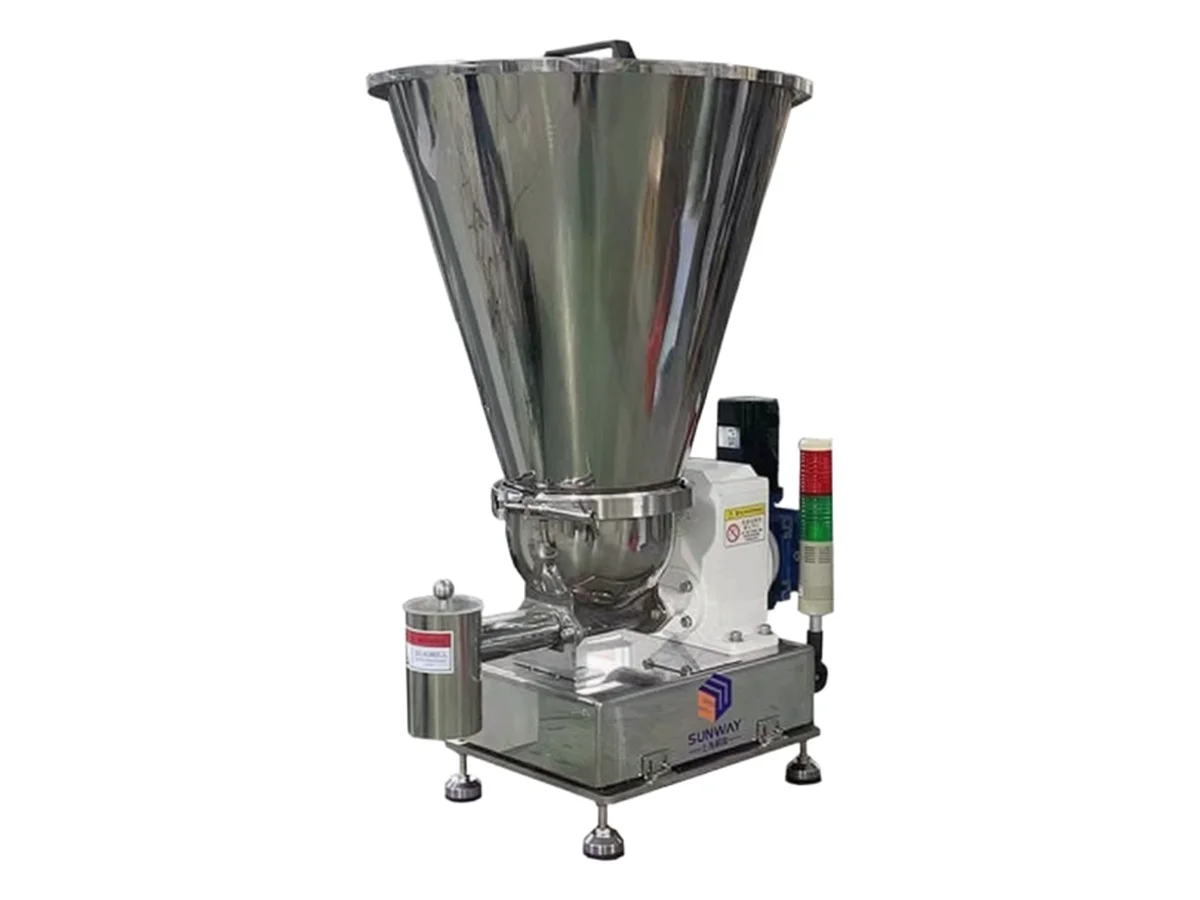
A volumetric feeder meters by volume: a screw, vane or belt delivers a defined swept volume per revolution, and the feed rate is set by adjusting speed. It is calibrated once, in mass per revolution, and then it assumes that relationship holds. A gravimetric feeder — usually a loss-in-weight type — mounts the whole hopper, metering device and drive on a weighing platform. The controller measures the declining total mass, calculates instantaneous mass flow, and adjusts speed through a closed loop to hold the setpoint. One measures position; the other measures weight. That is the entire difference, and it explains everything downstream.
Bulk density is the variable that moves
Powder bulk density is not fixed. It shifts with humidity, with the compaction a bag or container experiences in transit, with aeration during filling, and with particle size distribution between production lots. A shift of a few percent is entirely ordinary. On a volumetric machine it becomes a matching error in delivered mass, quietly, with no alarm, because the machine has no way to know. On a gravimetric machine the controller sees the deviation and corrects within a cycle. Whether that matters depends entirely on what the material costs and what the tolerance is.
Accuracy in context
Gravimetric feeders typically hold continuous dosing within a fraction of a percent of setpoint, and better still in batch mode where the endpoint is controlled directly. Volumetric feeders commonly land somewhere in the low single-digit percent range after range linearisation. Those bands overlap at the edges, and a well-maintained volumetric feeder on a very consistent product can do respectable work. The reliable way to choose is to ask what happens if the dose is off by three percent: if the answer is 'nothing', volumetric may be the better business decision.
The refill cycle and what it costs you
Gravimetric feeding in continuous mode has one structural complication — the hopper runs out and must be refilled. During refill the system cannot measure weight loss, so it switches to volumetric mode and runs at the last recorded speed. That means the accuracy of a gravimetric system is a weighted average over the cycle, not its closed-loop figure. Design therefore has to balance refill frequency against hopper size: frequent short refills spend too much of the cycle open-loop, while infrequent large refills need a larger, more expensive weighing platform. Getting this balance right is most of the engineering.
Where each one belongs on a real line
The recurring pattern in well-designed plants is asymmetry. Gravimetric feeders go on the ingredients where accuracy changes the product or the bill — actives, catalysts, colourants, expensive additives, low-dose premixes. Volumetric feeders go on bulk carriers and fillers where the material is cheap and a few percent either way is economically invisible. That split captures most of the available value at a fraction of the capital cost of gravimetric everywhere, and it avoids the false economy of putting volumetric control on an expensive ingredient.
What decides performance in either case
Feeding accuracy is not only about the control principle. Material properties matter: cohesion, particle size and shape, and flow behaviour in the hopper. Mechanical design matters: screw type and geometry, hopper outlet, agitation. Environment matters: vibration, air currents, temperature. And discipline matters: calibration and maintenance at fixed intervals. A gravimetric feeder installed with a rigid pipe bridge will underperform a correctly installed volumetric machine. The weighing system can only be as good as the mechanical freedom it is given.
Putting the requirement on the enquiry
Define the tolerance before you define the machine. State each ingredient, its bulk density and variability, the target dose rate, the acceptable deviation, and whether the line runs continuously or in batches. Say what feeds the hopper and how it refills, and give the hygiene class, ATEX zone and control interface. With that, the choice between gravimetric and volumetric becomes a calculation rather than a preference. CHUYAO configures both and will specify the simpler machine where the tolerance genuinely allows it.