Inflatable Seal Valves: Why the Seat, Not the Disc, Does the Sealing
A conventional butterfly disc scrapes its seat on every stroke. An inflatable seat retracts first and seals only at closure — and that single change explains the difference in life.
The seat stays retracted during rotation and inflates only at closure, so there is no sliding friction.
Inflation pressure must exceed line pressure by a defined margin; too low leaks, too high shortens seat life.
Trapped particles are tolerated rather than driven into the seat, which suits abrasive powder.
Torque requirements drop substantially, so a smaller actuator is often sufficient.
An eccentric construction keeps the disc clear of the seal through the whole stroke.
Technical Overview
The friction problem with conventional seats
In a standard soft-seated butterfly valve the disc is in contact with the seat through most of its travel. Every opening and closing sweeps the disc across the sealing surface under load. On liquids that is acceptable. On dry powder it is not: fines sit on the seat, the disc drives them into the elastomer, and the combination of abrasion and compression wears the seal until it leaks. The standard response — a harder seat — usually makes closing worse, because the tolerance for trapped particles drops.
How the inflatable seat works
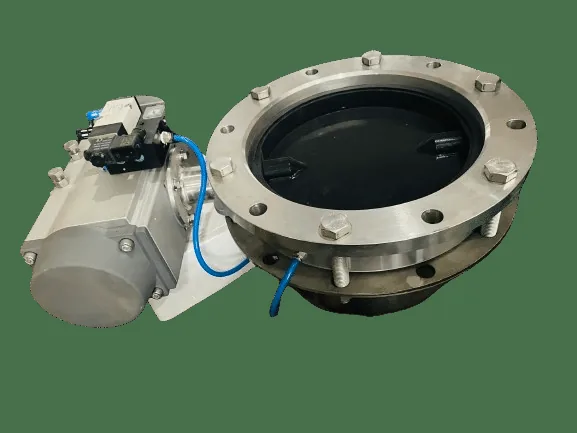
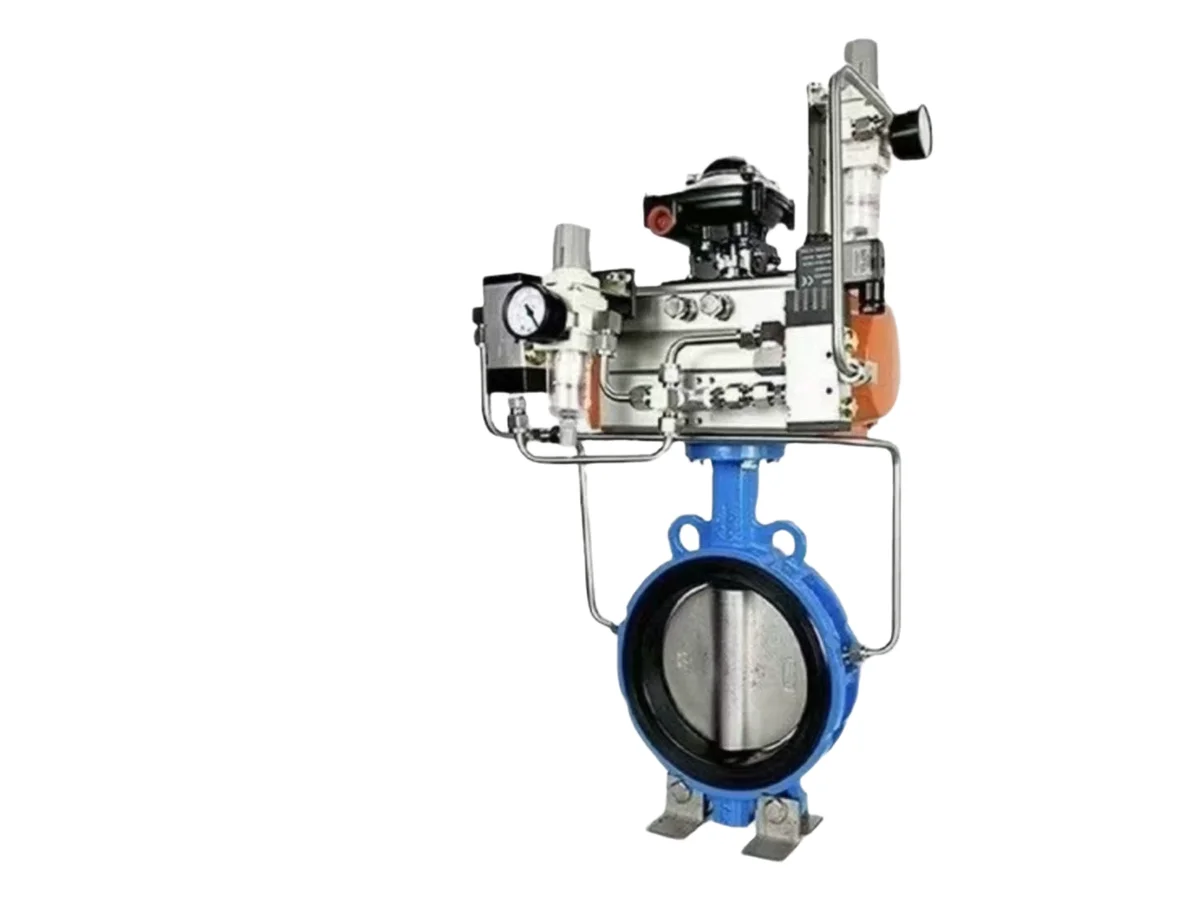
An inflatable seated butterfly valve — also called an expansion-seat or air-seat valve — turns that arrangement around. The seat is a moulded elastomer ring with a cavity behind it. While the valve is moving, that cavity is vented and the seat is relaxed, so the disc rotates with a clearance and no contact. Once the disc reaches the closed position, compressed air is admitted to the cavity and the seat expands uniformly around the disc circumference, pressing against it with even pressure. To open, the air is exhausted first, the seat retracts, and only then does the disc turn.
Why uniform pressure matters
Because inflation distributes sealing force around the whole circumference, there are no localised stress points. That has two consequences. The seal is genuinely dust-tight rather than tight only at the high spots, and the seat wears evenly instead of failing at one location. It also means trapped particles are tolerated: the seat simply expands around them, and the geometry wipes larger fragments clear as the disc closes. For abrasive mineral duty that tolerance is the whole point.
Setting the inflation pressure
The seat inflation pressure has to sit above the pressure in the line, with a defined margin. If it is too low, the seat cannot expand fully, a gap remains, and leaking product erodes the seat and then the body. If it is too high, the seat over-inflates and its service life shortens. In practice the setting is made against the actual feeding pressure, and it is worth recording that figure so a future change in line pressure triggers a re-check. This is the single most common commissioning adjustment on this type of valve.
Construction options
Bodies are offered in aluminium alloy, cast iron, carbon steel and stainless steel, with the choice driven by pressure, temperature, corrosion and hygiene. Discs and shafts are commonly an integral one-piece construction in stainless 304 or 316L, sometimes in Hastelloy, with surface options from standard satin through mirror polish to tungsten carbide or non-stick coatings. Seats come in a range of elastomers including white FDA-grade grades for food and pharmaceutical contact. The range of combinations is what lets one platform cover general industry through aggressive and abrasive duties.
Where it belongs, and where it does not
The inflatable seat earns its cost where the product abrades a conventional seat, where the valve cycles frequently, and where the seal has to hold reliably in both directions. Where the duty is a clean liquid, an occasional isolation, or a low-pressure air duct, a conventional valve is usually the better value. The honest approach is to specify against the product and cycle count rather than the valve type. CHUYAO supplies inflatable seal valves for silo outlets, filling heads and conveying line isolation, sized against the actual pressure differential and material.
Enquiry checklist
Provide the product, bulk density, particle size, abrasiveness, temperature and moisture; the line pressure and required differential; the bore and connection standard; the cycle frequency and actuation preference; the required construction materials and surface finish; and the hazardous-area classification. Include whether the valve must seal against pressure from either direction. With those answers the seat material, disc coating and actuator can be specified to the duty rather than to a default build.