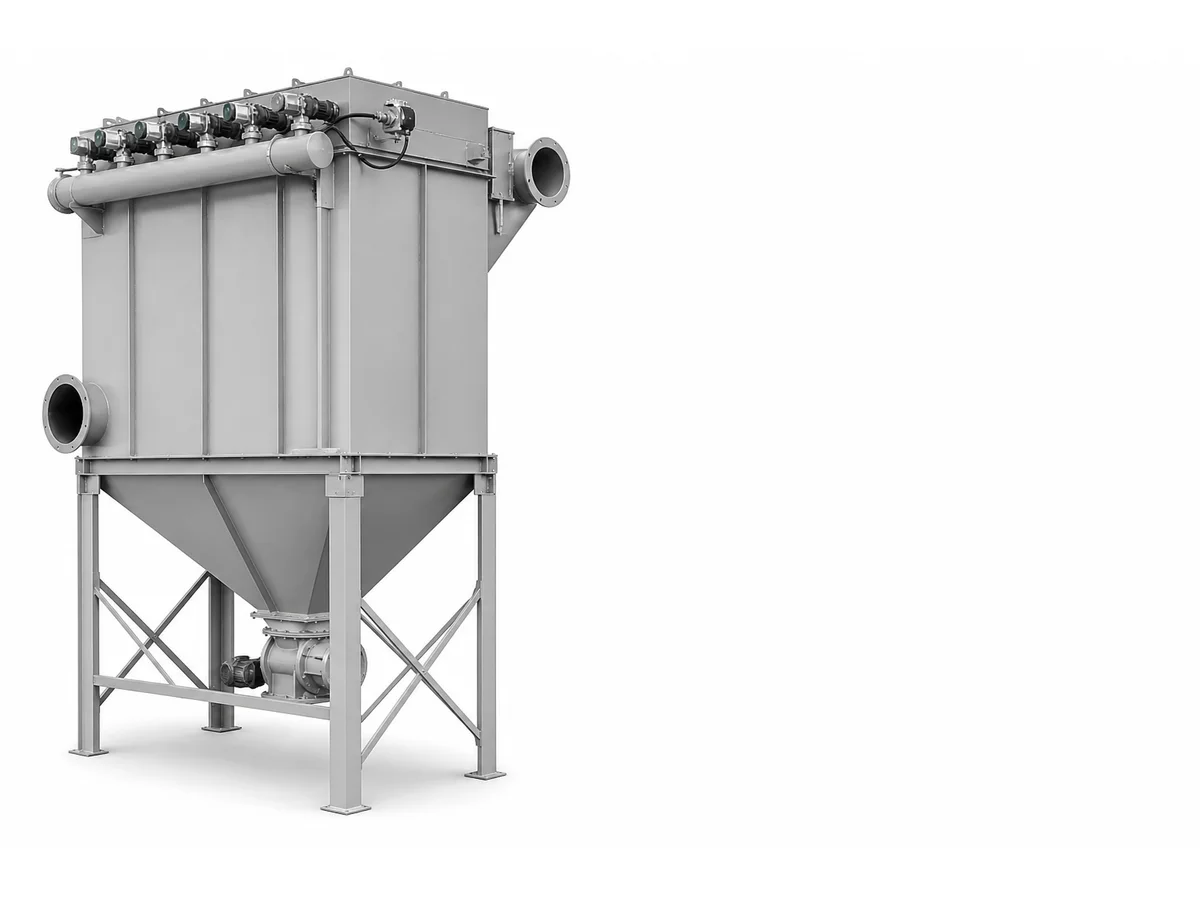
Pulse Bag Dust Collector Maintenance: Run It on Differential Pressure
Filter bags do not fail on a schedule. They fail when differential pressure stops recovering — which means the maintenance regime should be driven by the pressure trend, not the calendar.
Differential pressure is the single most useful health indicator for a fabric filter.
Cleaning on measured pressure drop beats cleaning on a fixed timer, in both air use and bag life.
Moisture in the pulse air is a leading cause of caked, blinded bags.
Overfilled hoppers re-entrain dust and make cleaning cycles ineffective.
Log the after-cleaning pressure trend; a slow drift is the early warning of blinding.
Technical Overview
Learn the normal pressure signature
A fabric filter does not filter with the cloth alone — it filters with the dust cake held on the cloth. When new bags are installed, differential pressure starts low and rises as the cake establishes; filtration efficiency actually improves during this break-in. Then the collector settles into a steady band, cycling between pulses. Operators who know their own steady band can spot a change within a shift. Those without a baseline cannot tell a developing problem from normal variation until production is affected.
Clean on pressure, not on a timer
A fixed-timer cleaning cycle fires regardless of condition: it wastes compressed air when the filter is clean and under-cleans when it is loaded. Cleaning on differential pressure uses air only when the duty requires it, which typically cuts compressed-air consumption by a useful margin and extends bag life by avoiding unnecessary flexing of the fabric against the cage. Either way the pulse air must be dry and oil-free; a moisture carry-over into the pulse line shows up as caked media and a capacity complaint that looks like a fan problem.
Hopper discipline
The hopper is not a storage vessel. Once it fills past roughly three quarters, dust dislodged by the pulse cannot fall clear — it is drawn straight back onto the bags, and the cleaning cycle achieves nothing while consuming air. Set the discharge schedule from the actual dust generation rate; high-loading applications may need emptying more than once a shift. A rotary valve or double-flap valve at the hopper outlet also acts as the airlock that keeps the collector under the intendednegative pressure.
When bags are actually finished
Replace on condition, not on a date. The signal is a differential pressure that no longer falls back to its normal band after a full cleaning cycle, or a cleaning interval that has become very short. Inspect on a fixed schedule using a leak detection method — fluorescent powder or a triboelectric monitor both work — and replace the whole set rather than individual bags, because a mixed set gives uneven airflow and the new bags attract the load. Where a single bag has failed, find the cause before restarting; a hole usually means abrasion from a bent cage, a misaligned pulse, or a bag rubbing against a neighbour.
Operating conditions that shorten bag life
Temperature and chemistry do most of the damage. Sustained operation above the media's rating, or a brief excursion during a dryer upset, can destroy a full set in hours. Condensation below the dew point makes dust sticky and drives hydrolysis in some fibres. Acid or alkaline gas attack specific media, which is why the fabric has to be chosen against the actual gas composition rather than a generic duty description. Abrasive dust wears the fabric mechanically, usually at the cage contact points first.
Safety around the collector
Where the collected dust is combustible, the collector is often the largest connected vessel in the system and the highest-consequence location for an ignition. Earthing and bonding must be complete and verified, including the cages and the pulse valves. Explosion venting, flameless venting or suppression, and isolation on the inlet duct all have to be determined by the documented assessment. None of these can be added casually after installation, and painting over a vent panel or storing material against it is enough to render the protection useless.
A cadence that fits real shifts
Daily: check differential pressure, confirm hopper level, verify compressed air pressure, walk the duct for leaks. Weekly: inspect bags for tears or blinding, confirm each solenoid fires in sequence. Quarterly: check cage condition, verify relief devices, calibrate pressure sensors. Annually: full audit, filter life review, structural check. Record every reading, however briefly — a slow upward drift of the after-cleaning pressure over months is the clearest signal that the media is approaching the end of its useful life.