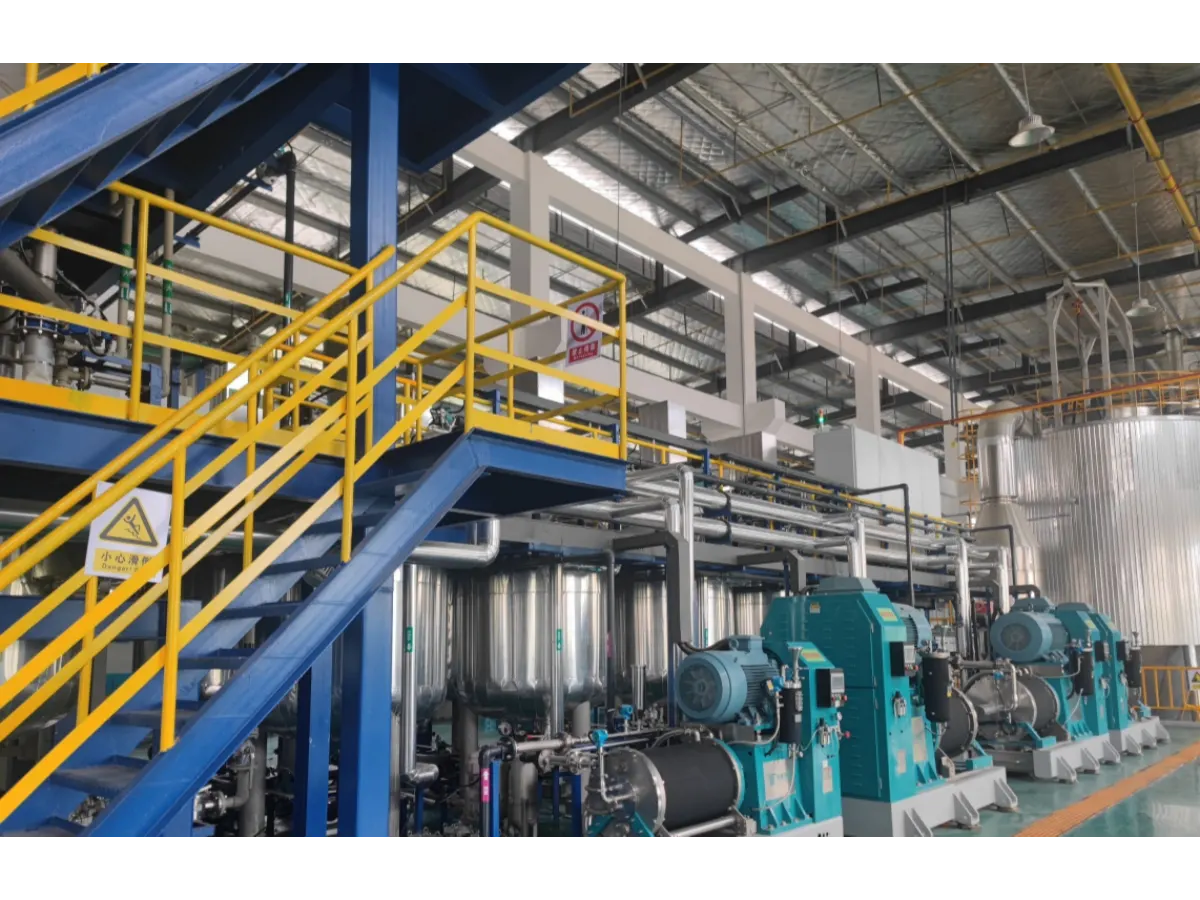
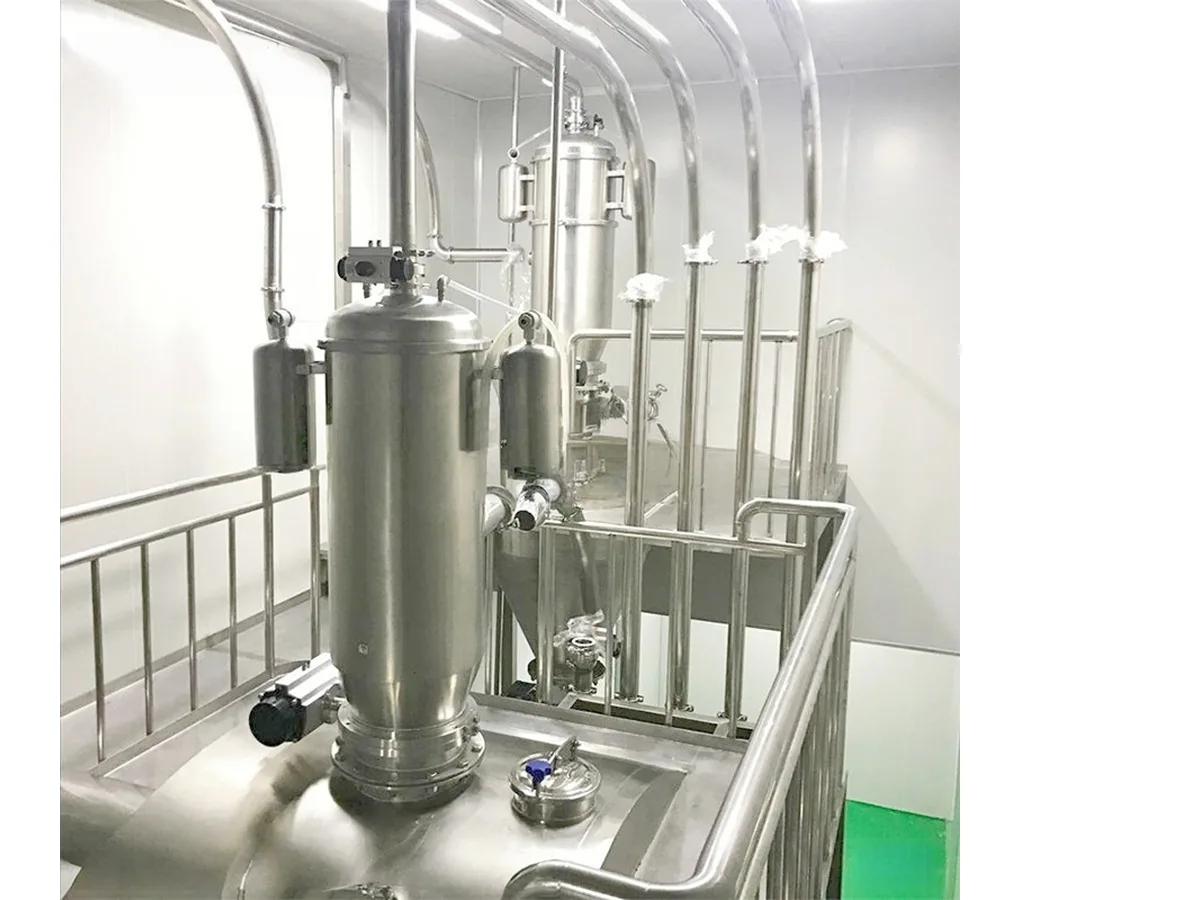
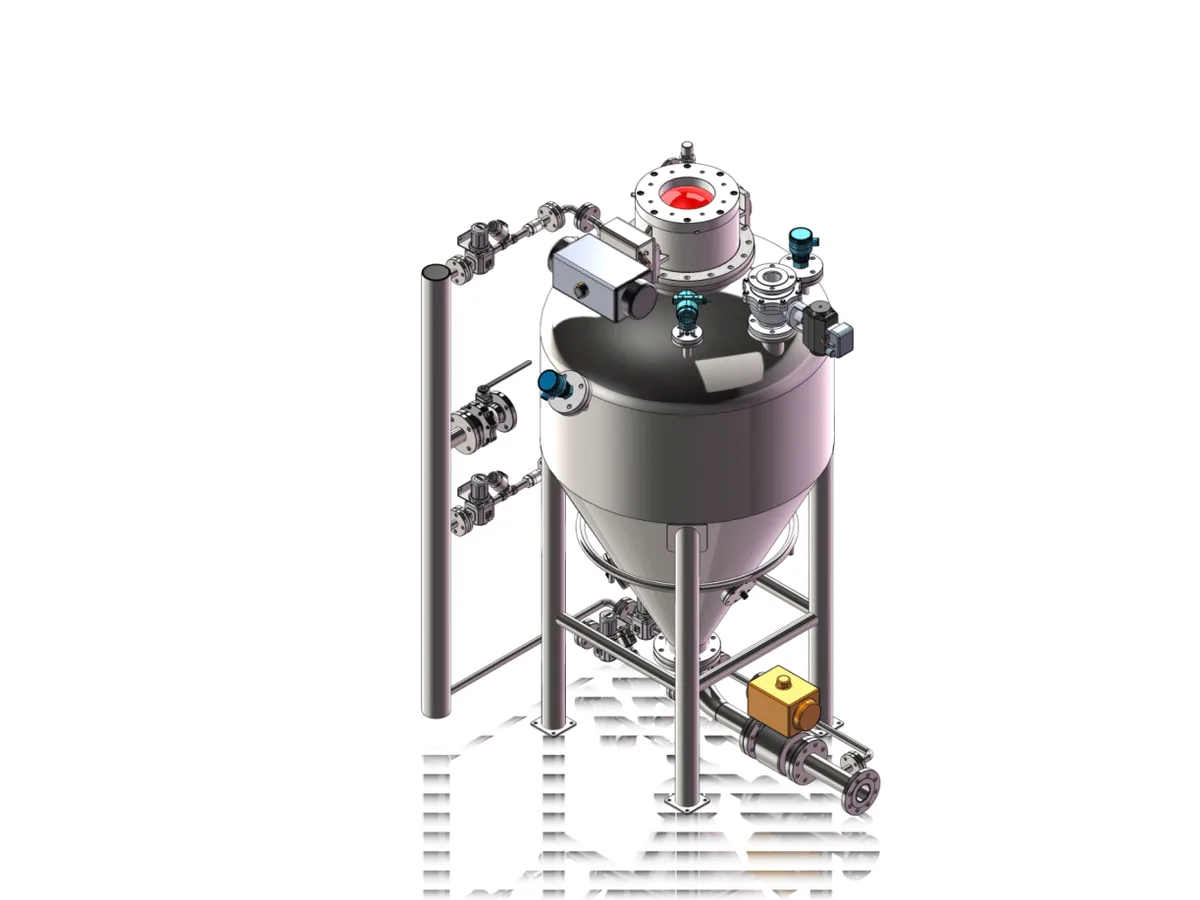
Battery powders need contamination-free, enclosed transfer.
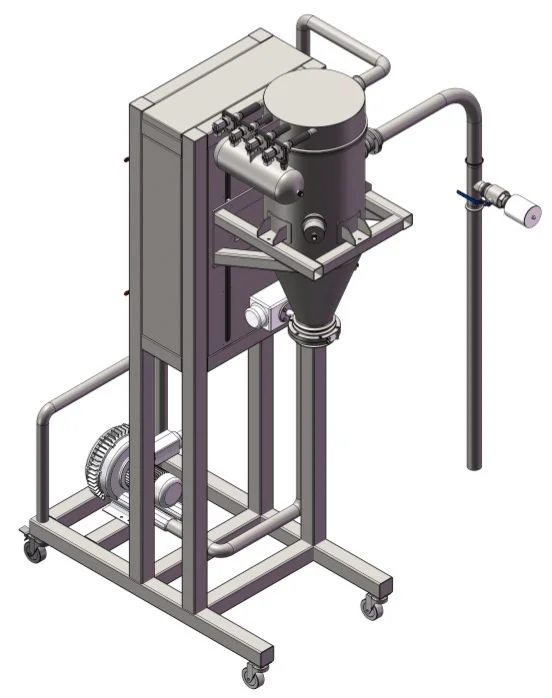
Vacuum conveying supports precise dosing into mixers and coating lines.
Dust and moisture control protect product quality and safety.
Gravimetric dosing holds accuracy against mass, not against screw volume.
Keep cathode and anode equipment separate rather than relying on changeover cleaning.
Technical Overview
Why containment matters
Cathode and anode powders are sensitive to moisture, cross-contamination and operator exposure. Enclosed vacuum conveying and sealed hoppers keep material quality stable from warehouse to process — not only because open transfer lets humid air reach the powder, but because these materials carry a genuine health and explosion risk. Many battery powders are fine enough to stay airborne for hours and are classified as combustible dust, so containment is simultaneously a quality measure and a safety one. In practice the same design decision serves both: keep the material inside a closed path, keep the air around the operators clean, and earth every conductive part of that path.
Enclosed transfer serves product quality and operator safety at the same time
Dosing accuracy for battery lines
Accurate loss-in-weight feeding after conveying improves batch consistency. Systems are often stainless or coated, with nitrogen blanketing options where required. The numbers worth designing around are modest but consequential: a gain-in-weight hopper holds a batch to within a few tenths of a percent of setpoint on a well-tuned installation, while a continuous loss-in-weight feeder holds its set rate to roughly half a percent to one percent. Both figures are measured against the mass actually delivered, which is why gravimetric feeding is specified instead of volumetric — a screw that displaces a consistent volume still delivers a varying mass whenever bulk density drifts, and battery powders drift. Refill strategy matters as much as the feeder: a refill that disturbs the weighing vessel for several seconds at a time will show up directly in the delivered weight, so the control scheme has to compensate for it.
Gravimetric dosing holds accuracy against mass, not against screw volume
Design points for battery material lines
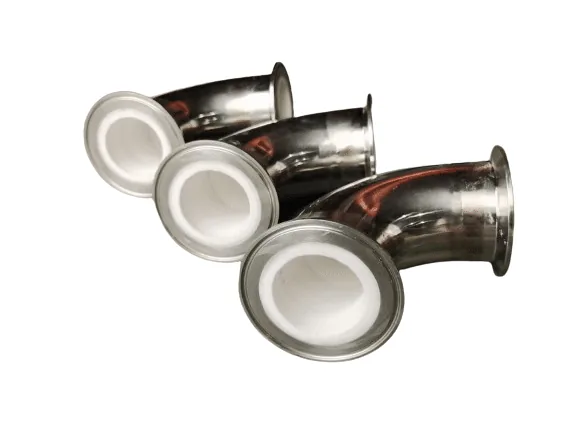
When specifying a system for cathode or anode powder, confirm the bulk density and angle of repose first, because they set the pipe diameter and conveying velocity. Keep transfer distances short where possible, use ceramic or wear-resistant elbows on abrasive NCM and graphite grades, and earth-bond every component to dissipate static charge. Adding a nitrogen blanket and dew-point monitoring on the receiving hopper protects moisture-sensitive material, while inline metal detection and a rotary valve screen prevent tramp metal from reaching the mixer. Documenting these choices in the FAT protocol makes qualification and later audits considerably easier.
Ceramic-lined bends on abrasive cathode grades, and an earth-bonded pipeline throughout
Bridging and flow: these powders are not flour
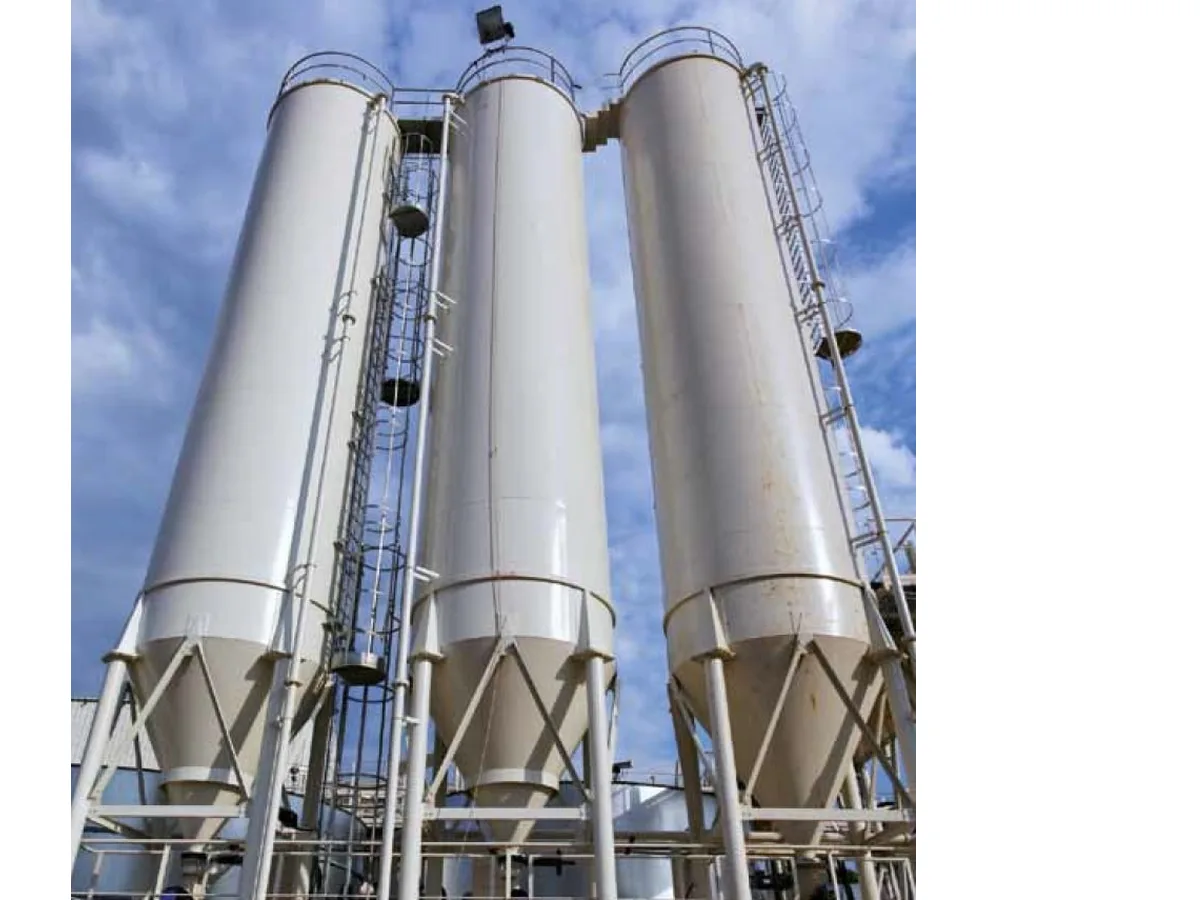
Cathode and anode powders are fine, often cohesive, and frequently arrive at a bulk density that changes with handling — exactly the combination that bridges in a hopper and pipes in a line. The first measure is geometry: a cone steep enough and an outlet large enough that material moves under its own weight. Where geometry alone will not do it, an activation hopper with a slow geared agitator keeps product moving to the outlet without the violent shearing a high-speed stirrer would inflict on coated particles. Vibrators help some powders and compact others, so they should be applied deliberately rather than fitted by default; in a weighing hopper the choice between an air pad, an agitator and a vibrator depends on whether the problem is friction, cohesion or moisture. Because behaviour changes with moisture and with time at rest, a weekend shutdown is often the harshest test a battery powder line ever faces — worth reproducing during commissioning rather than discovering on a Monday morning.
Slow agitation keeps cohesive powder moving without shearing coated particles
Keeping cathode and anode lines apart
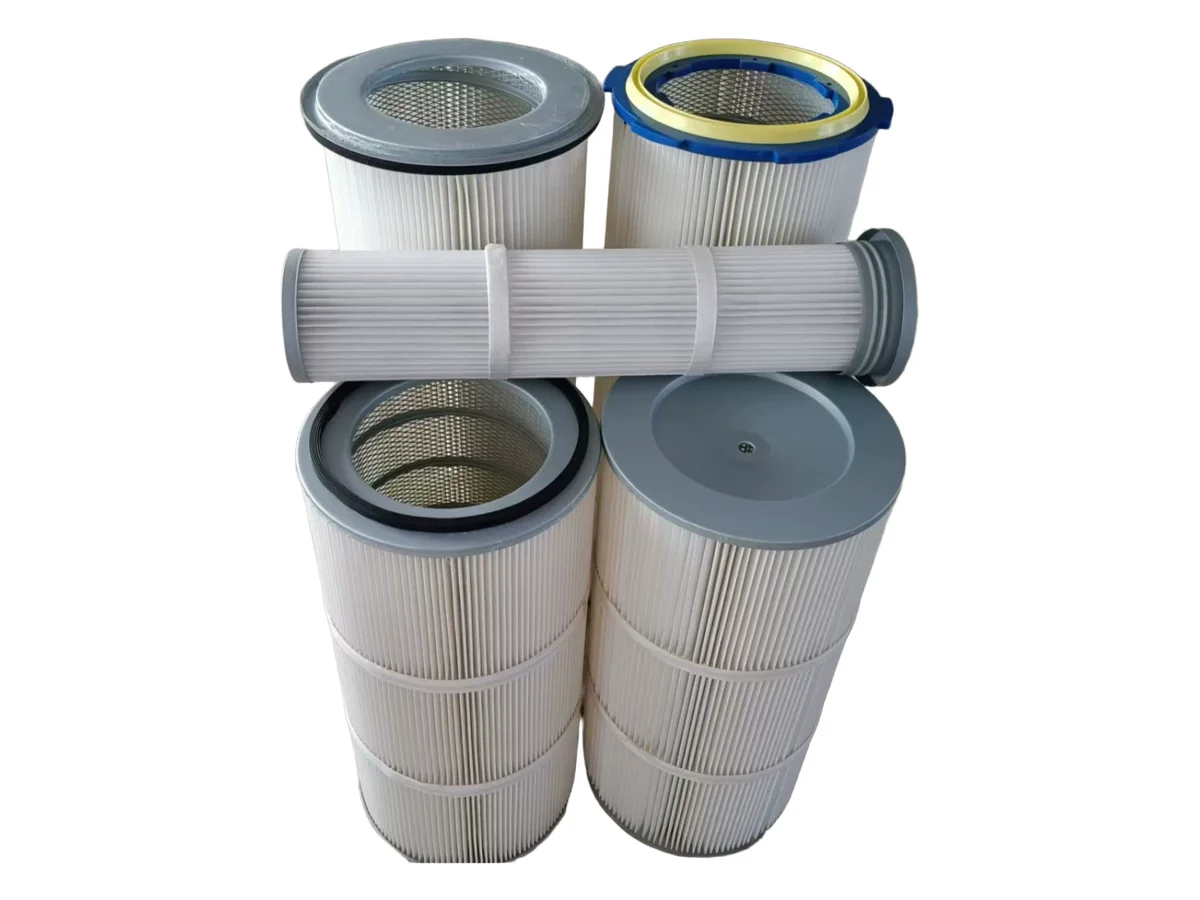
Cathode chemistry is built on transition metals, and an anode is designed to avoid them. That makes cross-contamination between the two sides of a plant a quality problem rather than a housekeeping one, and the usual answer is to keep the equipment apart rather than rely on cleaning between campaigns. In practice that means dedicated receivers and feeders for cathode and for anode material, separate filter elements, and separate intake stations where powder arrives. Where a shared component cannot be avoided, specify quick-release assemblies so the part can be removed and cleaned instead of wiped in place, and record the changeover the way you record a batch. The same discipline applies to graphite: it is soft enough to embed itself in seals and clearances, and equipment that has run anode material is difficult to return to a clean condition without replacing the wearing parts.
Dedicated receivers, feeders and filter elements instead of changeover cleaning
Batch release: weighing, sampling and traceability
Battery qualification audits ask for evidence, and the weighing system is where most of that evidence is generated. Recipe management with lot tracking turns individual readings into a record: which lot of which ingredient went into which batch, at what weight, and when. That record is what makes a failed cell traceable back to its inputs instead of triggering a bulk recall, and it is difficult to reconstruct after the fact. Sampling points designed into the line help here too, because a sample drawn from a sealed receiver under controlled conditions is far more defensible than one scooped from an open bag. Where a plant runs many formulations, a controller handling ten or more recipes without a manual data transfer is worth specifying at the outset, since retrofitting recipe management later touches every part of the line.
Traceable weights plus controlled sampling are what an audit actually asks to see
What to prepare before requesting a quotation
Powder handling for battery materials is sized from the material and the cell chemistry, so the useful information is specific. Collect the exact grade designation and supplier of each powder, its loose and tapped bulk density, particle size distribution and typical moisture content, plus whether it arrives in sacks, FIBCs or bulk containers. State the batch size and cycle time, and the accuracy the formulation genuinely requires — a requirement of half a percent and one of two percent lead to different equipment and different budgets. Note the number of ingredients, including minor additives, and any that must be dosed at very low rates. Finally, describe the environment: whether an inert atmosphere is needed, the dust explosion classification, the cleaning and changeover regime, and the documentation the qualification process will demand.
Grade, bulk density and required accuracy decide the equipment long before layout does
Process Flow
Typical steps covered in this article.
Raw Powder Intake
Enclosed Transfer
Precision Dosing
Mixing / Coating
Typical Applications
Cathode materials
Anode materials
Electrolyte additives
Precursor powders
Equipment
Related Products
Explore equipment commonly used with the processes described in this article.