How a Dust-Free Tip Station Captures Powder at the Source
A sack tip station is not a hood with a fan bolted on. It is a containment boundary where capture velocity, hood geometry and filter cleaning have to work together — this is the engineering behind it.
A tip station works by holding an inward airflow at the operator opening, not by sucking hard after the dust has escaped.
Capture velocity must exceed the settling behaviour of the specific powder, which is why generic fan sizing under-performs.
Onboard cartridge filtration with reverse-pulse cleaning returns captured powder to the process instead of sending it to waste.
Hood geometry — three-sided enclosure plus top — stops lateral migration that a simple canopy hood cannot.
For combustible dusts the station is an ATEX boundary: earthing, bonding, anti-static media and venting belong in the original scope.
Technical Overview
The job of a tip station
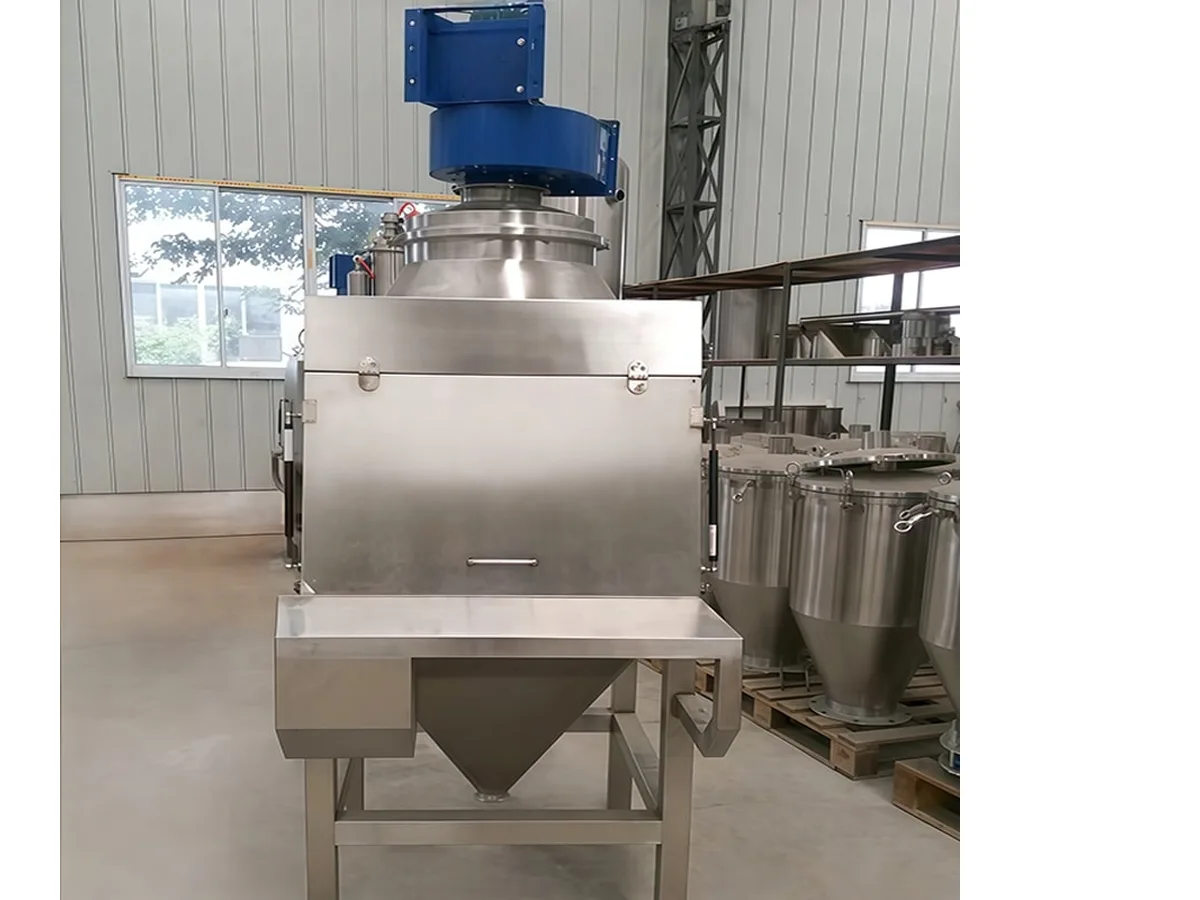
Emptying a 25 kg sack by hand is, in most powder plants, the single highest-exposure task on the floor. The operator stands directly over the material, cuts the bag, shakes it, and every fine fraction that becomes airborne travels first through their breathing zone. A dust-free tip station — variously called a sack tip station, bag dump station or manual bag emptying station — exists to invert that airflow. Instead of dust moving outward past the operator, air is drawn inward through the tipping opening, carrying fines away from the person and into a filter element mounted in the same enclosure. The distinction matters: a canopy hood above a bench attempts to catch dust that has already escaped into the room air, and its performance collapses the moment a cross-draught, a passing forklift or an open door disturbs the air. A properly designed tip station encloses the task on three sides and the top, so the only path for airborne powder is into the filter.
Capture velocity is the design variable that counts
The performance of the station is set by the velocity of air moving inward across the open face — the capture velocity. It has to be high enough to overcome the powder's tendency to settle under gravity and to resist the outward puff generated when a sack is shaken out. Free-flowing granular products are forgiving. Cohesive, aerated or very fine powders are not: they form a cloud that lingers and drifts, and a marginally sized fan will let part of it escape. This is why a station quoted purely on fan motor power often disappoints on site. The figure that should appear on a specification is the face velocity at the working opening under worst-case conditions — filter loaded, doors open, extraction at minimum. Where that number is not stated, it has usually not been calculated.
What sits inside the enclosure
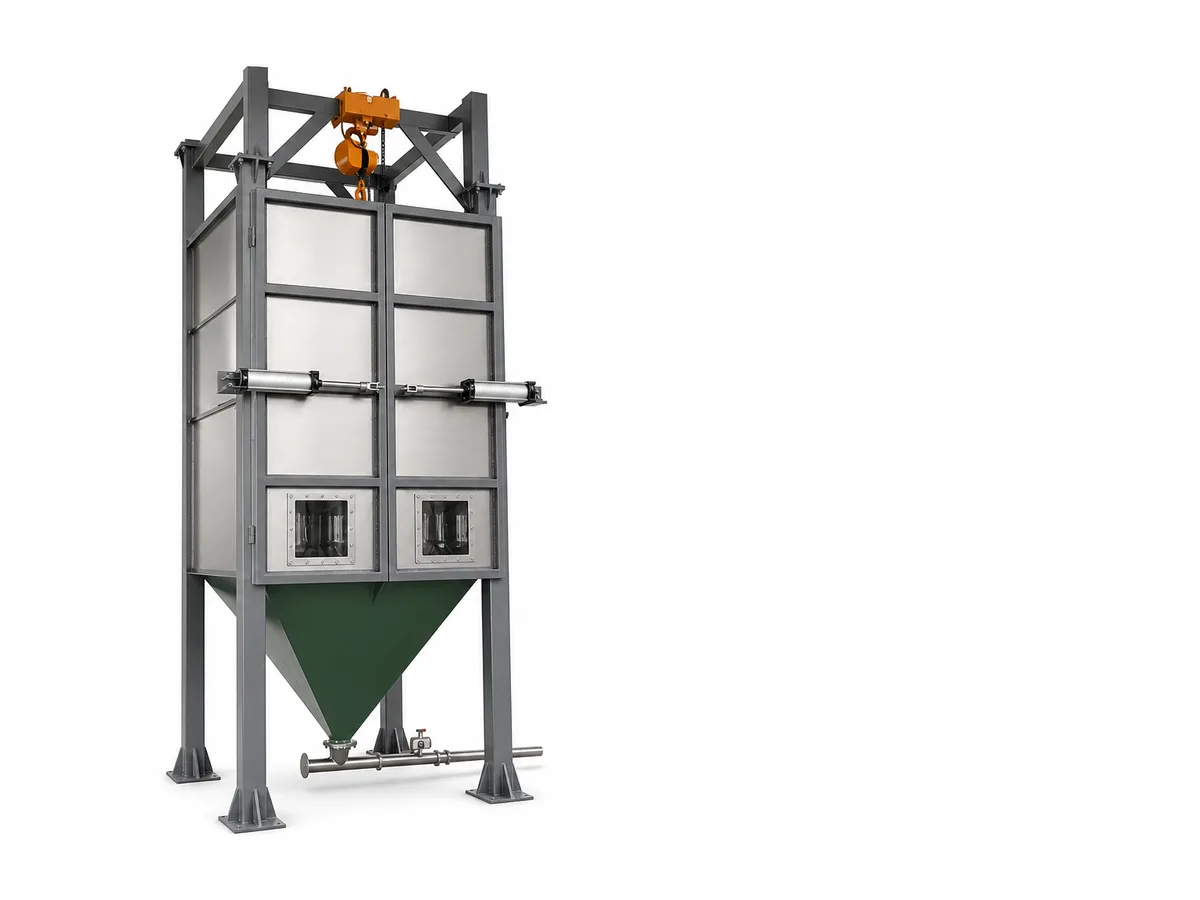
The mechanical parts are simple. A load-rated grate or perforated shelf supports the sack and catches tramp material, string and bag fragments before they can enter the product stream. Below it a collection hopper, sized as a buffer for one or more sacks, directs powder to the discharge device — typically a butterfly valve, slide gate, rotary airlock or the pickup adapter of a vacuum conveyor. A hinged, sealed access door with an interlock lets the operator load and close before the fan runs. In pharmaceutical or potent-compound service the front may be replaced by a glove-box isolator with a continuous liner for spent sacks. Material choices follow the duty: 304 stainless for general food and chemical work, 316L where chlorides or aggressive cleaning agents are present, ground welds and a fine surface finish where wash-down validation is required.
Filtration and why pulse cleaning changes the economics
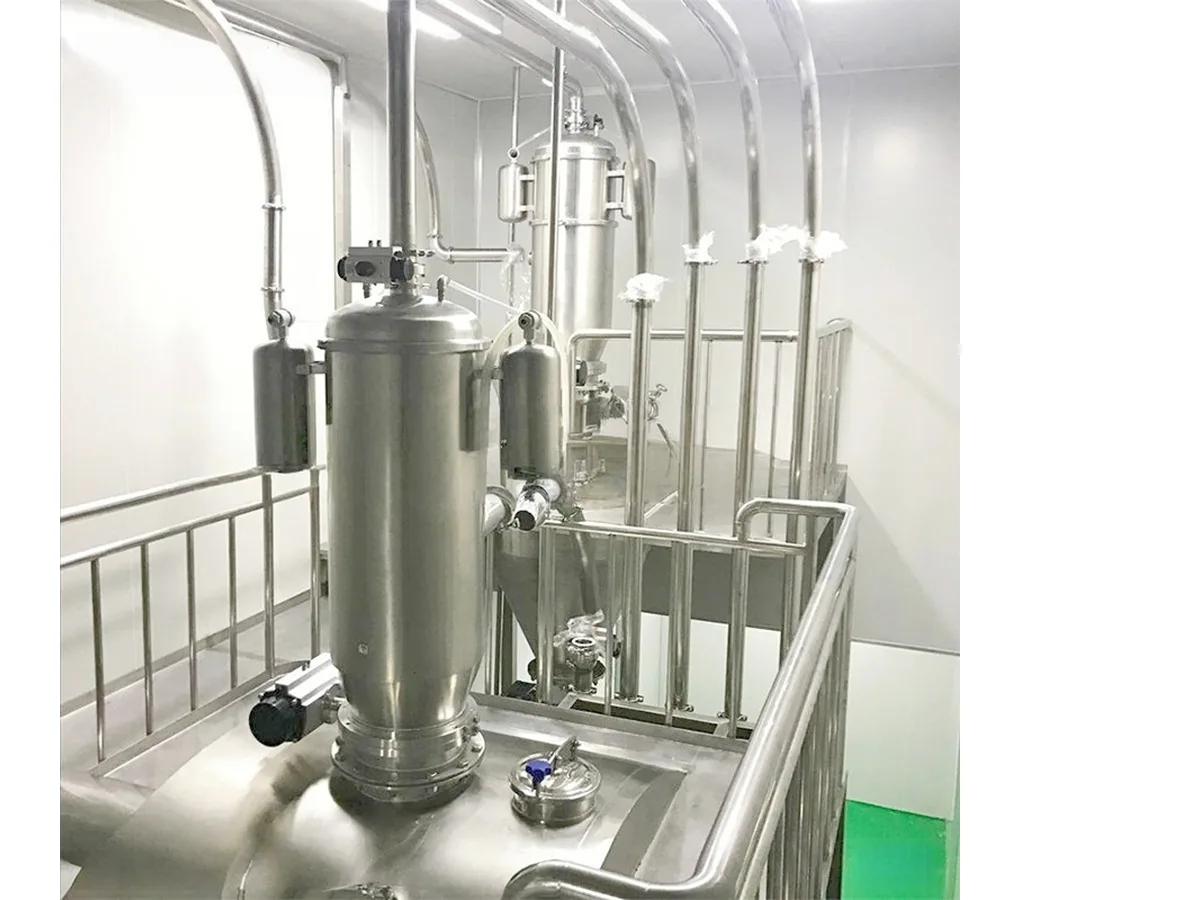
Self-contained stations carry their own filter, usually a pleated cartridge rather than a bag, because the envelope is tight. Filtered air is either recirculated into the room through a final filter or ducted outside, depending on the material and the site's emission permit. The part that usually decides the operating cost is the cleaning method. A reverse-pulse system fires a short burst of compressed air through a venturi inside each cartridge at a set interval, dropping the dust cake back into the hopper rather than into a waste bag. Over a year, on a high-value powder, recovered product is frequently the largest single line in the business case — and it is the line most often omitted from the comparison between an engineered station and a welded hood.
Sizing the station to the real job
Four questions drive the configuration. What is the bag — 5 kg paper sacks, 25 kg woven poly, 50 kg multiwall — and how is it presented to the grate; a station that forces the operator to lift 25 kg to shoulder height will be bypassed or will cause injury. What throughput is expected, measured in bags per hour at the shift peak rather than as a daily average. What is the material — bulk density, particle size, moisture, cohesion, and whether it fluidises and floods or packs and bridges. And what receives the powder: a mixer, a screener, a reactor, or the inlet of a pneumatic line. Each answer moves the design: grate aperture, hopper volume, discharge valve, filter area and the fan curve.
Combustible dust: the station is the boundary
A tipping station is typically the point where a dust cloud originates, which makes it the logical starting point for a dust hazard analysis. Internal volume is normally classified as Zone 21, with the surrounding room at Zone 22. The practical measures are well established: earth-bond and continuity-test every conductive part, including flexible connections; specify anti-static or conductive filter media; avoid designs that create unnecessary fines; and provide explosion venting or suppression determined by the documented assessment for the specific dust. The important point is that these requirements belong in the original enquiry, not in a retrofit. A station delivered without grounding provisions cannot be economically upgraded later, and a vent panel added after installation usually needs structural work.
Where the tip station connects
In an integrated powder line the tip station is the first element of a chain: intake, conveying, screening or conditioning, weighing and dosing, mixing, then packing. Because the station determines how cleanly the process starts, it influences everything downstream — less fugitive dust means longer bearing life, fewer filter changes, less cleaning labour and a simpler hygiene audit. CHUYAO designs the intake station together with the conveying and dosing equipment that follows it, so the grate height, hopper outlet and discharge flange are settled against the actual plant layout rather than assumed from a catalogue.
Process Flow
Typical steps covered in this article.
Bag Placement on Grate
Slitting & Tipping
Inward Airflow Capture
Cartridge Filtration
Powder Returns to Hopper
Typical Applications
Manual charging of 25 kg sacks into mixers
Food and dairy ingredient intake under hygiene rules