Container Unloading System Integration: What to Settle Before Delivery
Container unloaders rarely fail because of the machine. They fail because of the interface — where the container sits, where the powder goes, and who stops the fan when something blocks.
Integration risk sits at the interfaces: container positioning, discharge take-away, dust control and controls.
Confirm the container type and liner arrangement before the machine is built, not at commissioning.
Dust control has to handle the displaced air from the whole container volume, not just the product stream.
Define the stop logic for blockages and the container-empty condition in the control philosophy early.
Plan access for cleaning, filter changes and maintenance from the layout stage.
Technical Overview
The interface is the project
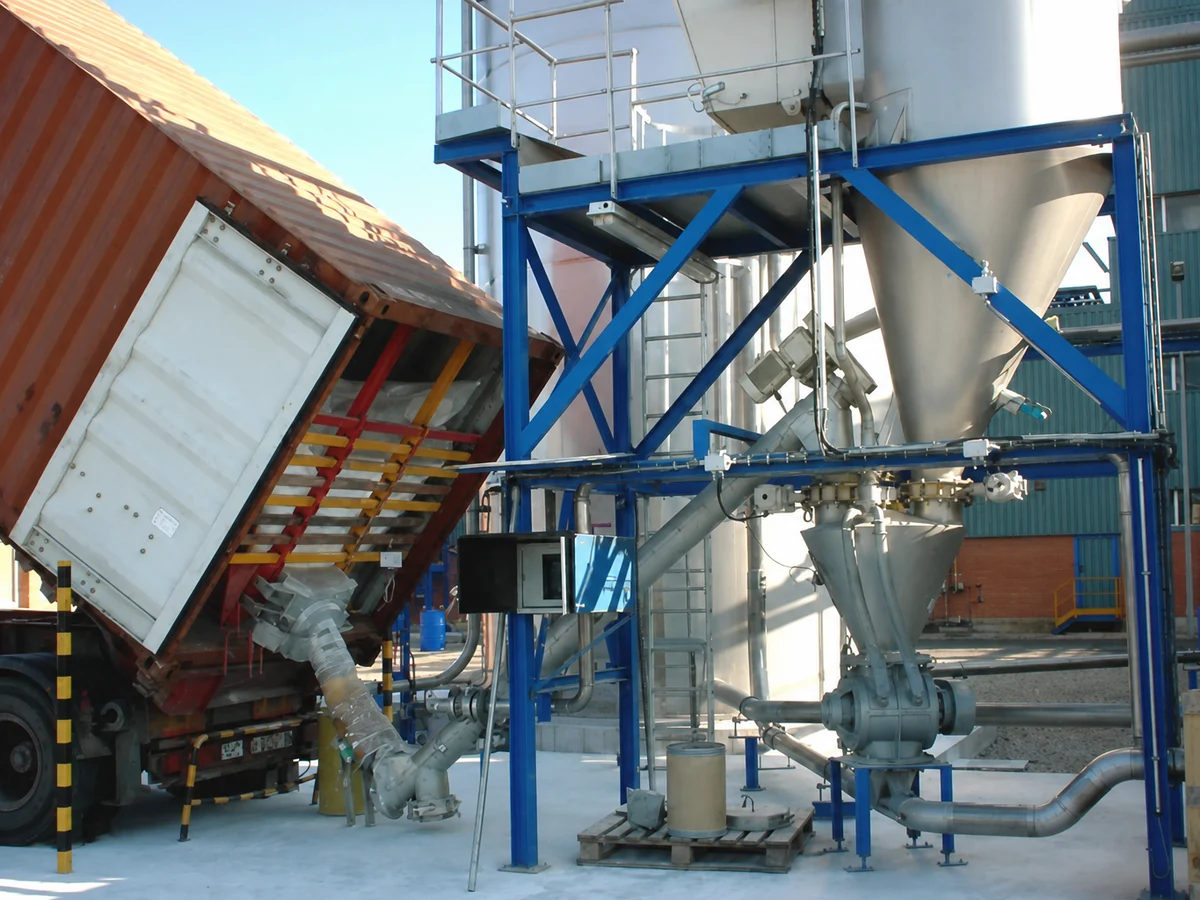
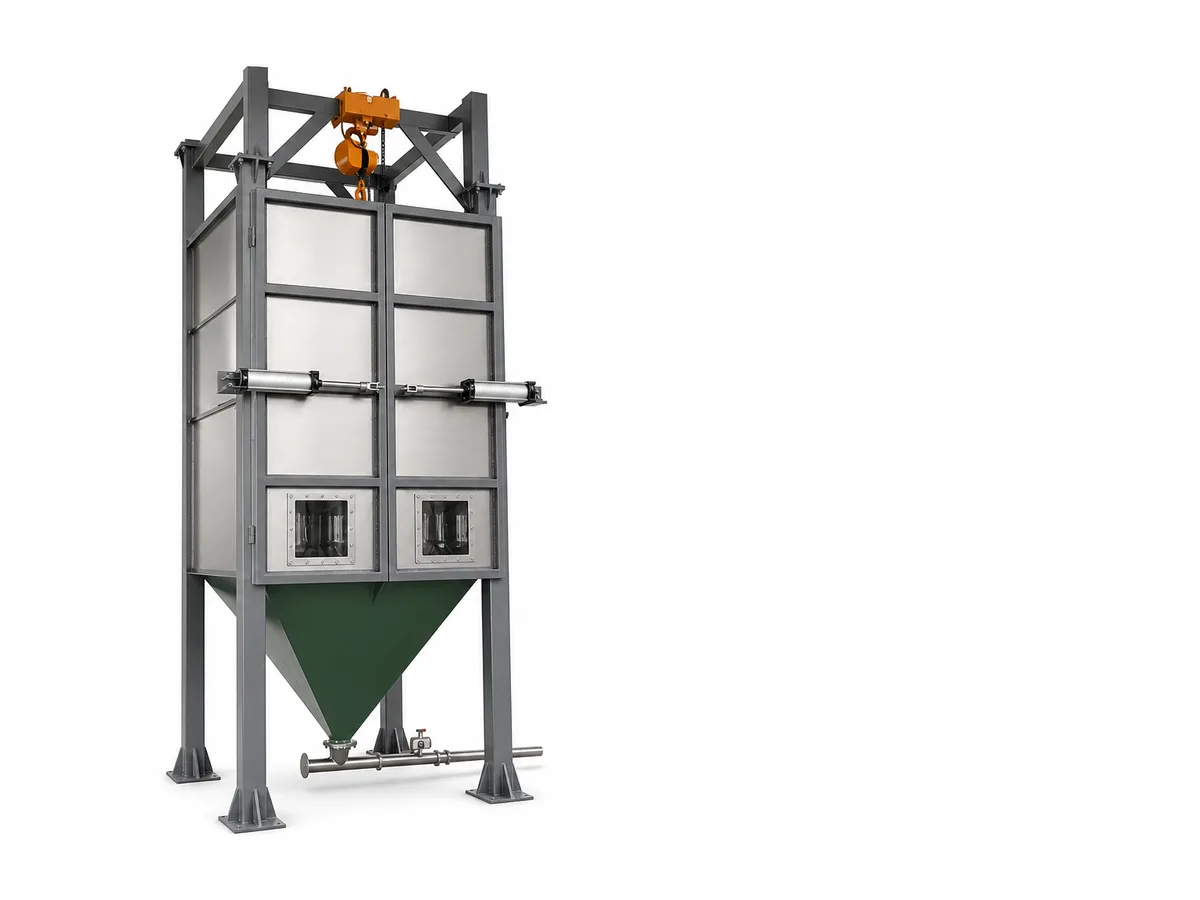
A container unloader sits at the boundary between two logistics systems that were usually designed independently: the shipping side, which delivers a lined steel box, and the plant side, which expects powder at a controlled rate. Almost every difficult commissioning can be traced to a decision at that boundary that nobody owned. The machine itself — tipping frame, hydraulic tilter, screw extraction or suction lance — is mature technology. What varies between projects is the level surface, the container fleet, the liner type, the take-away conveyor, the dust collector and the control system handshake.
Container and liner: settle it first
The first question is what actually arrives. Standard ISO freight containers with disposable liners behave differently from purpose-built bulk containers with integrated fluidisation. Lined containers need the liner supported as the container tips, and the liner outlet has to reach the extraction point without tearing or folding back on itself. Flow from a tipped container is only reliable if the powder is fluidised, either by the liner's built-in aeration or by mechanical assistance at the extraction head. Confirm the container sizes handled, the door arrangement and who opens it, and whether the liner is cut, clamped or drained through a spout.
Positioning, levelling and structure
Tipping a loaded container moves a very large mass through a large angle, so the foundation and the frame take real load. Verify the ground bearing, the slab flatness and the drainage. If the station is outdoors, the hydraulic power unit, the electrical enclosure and the control panel need weather protection rated for the site, not merely a cover. Maintenance access is the other half of this decision: filters come out, screws and seals wear, and extraction heads need attention. A layout that puts the service point against a wall will cost hours on every intervention.
Where the powder goes next
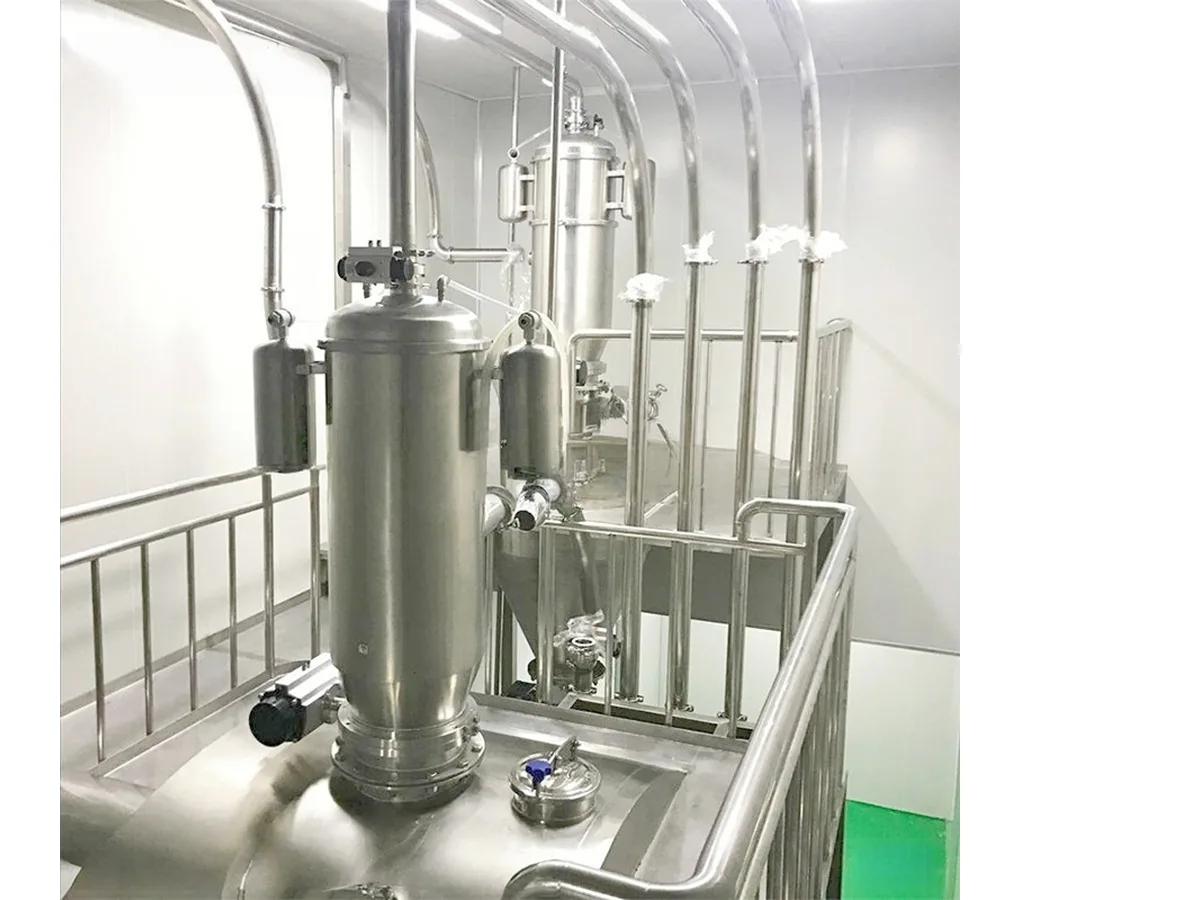
The unloader is only half a system. Its discharge has to match the take-away: a screw conveyor, a chain or belt conveyor, a pneumatic line, or a hopper feeding a weigh system. Mismatched rates are the classic failure — the unloader can move far more than the downstream line accepts, the hopper fills, and the whole station trips. Settle the nominal and peak rates on both sides, agree what happens when the receiving equipment stops, and make sure the interface flange, height and dust-tightness are drawn rather than assumed.
Dust control sized for displaced air
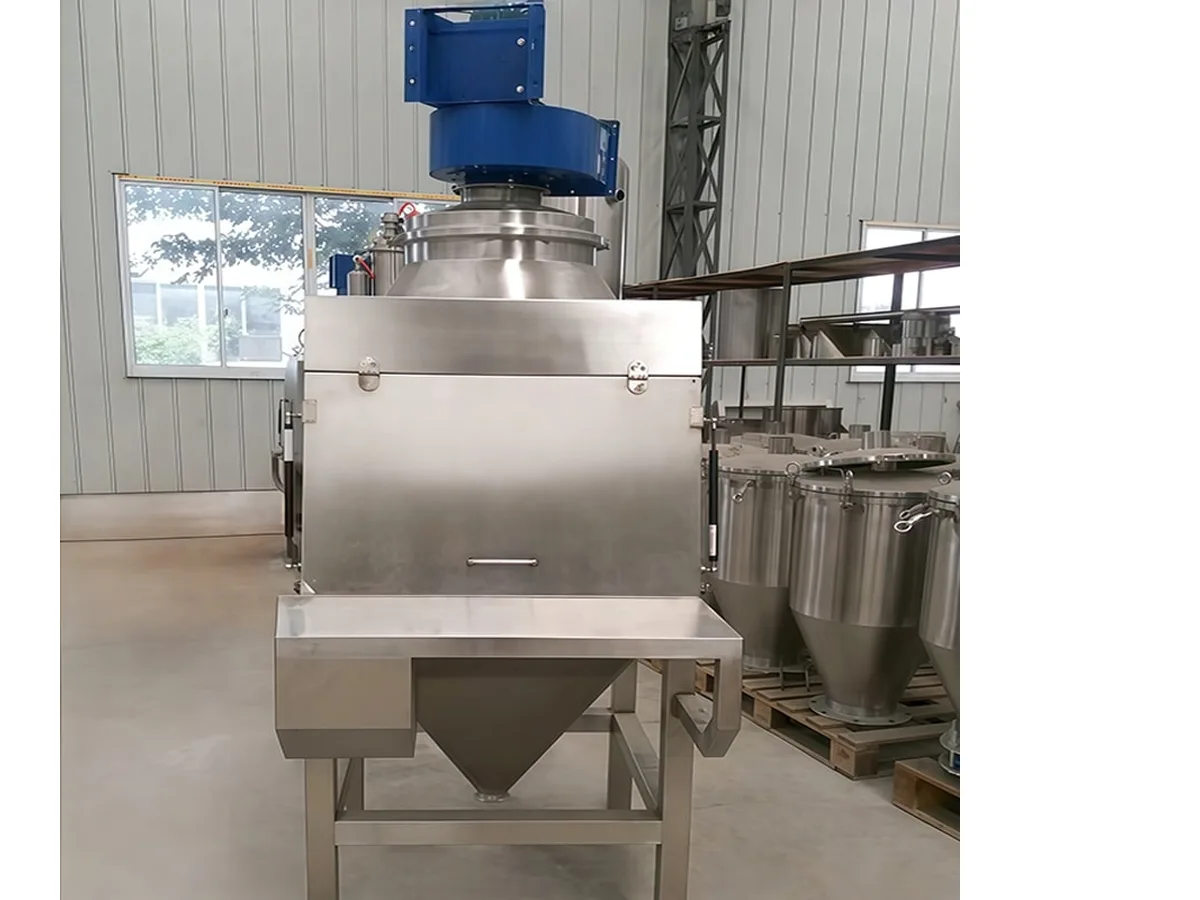
Filling or emptying a container displaces a substantial volume of air, and that air carries fines. Extraction has to be sized for the displaced volume plus the entrained product, not just for the product flow. The enclosure around the door and liner outlet should be held slightly negative so any leakage is inward. Where the product is combustible, the collector and the unloader frame fall inside the same dust hazard analysis, which affects venting, isolation, earthing and the rating of every electrical component in the zone.
Controls, interlocks and stop logic
Container unloading is cyclic but not continuous, so the control philosophy does most of the work. Define how the sequence starts — fan before feeder, always — and how it stops: blockage detected by pressure or vacuum threshold, container empty by weight or level, receiving equipment unavailable, emergency stop. Every automatic stop needs a defined restart path that an operator can follow without calling for help. Include position feedback on the tipping frame and the extraction head, since a valve or cylinder that fails to reach position is a common cause of unexplained trips.
Commissioning and handover
Agree before delivery what a successful start-up looks like: rate to be demonstrated, for how long, with which material, and against what emission measurement. Test with the real product rather than a substitute, since flow behaviour is the variable most likely to surprise. Build the maintenance schedule from the commissioning data — filter differential pressure trend, cycle times, lubrication intervals — rather than from a generic manual. CHUYAO supplies the unloader as part of the connected handling line, so the mechanical interface, control handshake and dust system are settled together and proven at start-up.