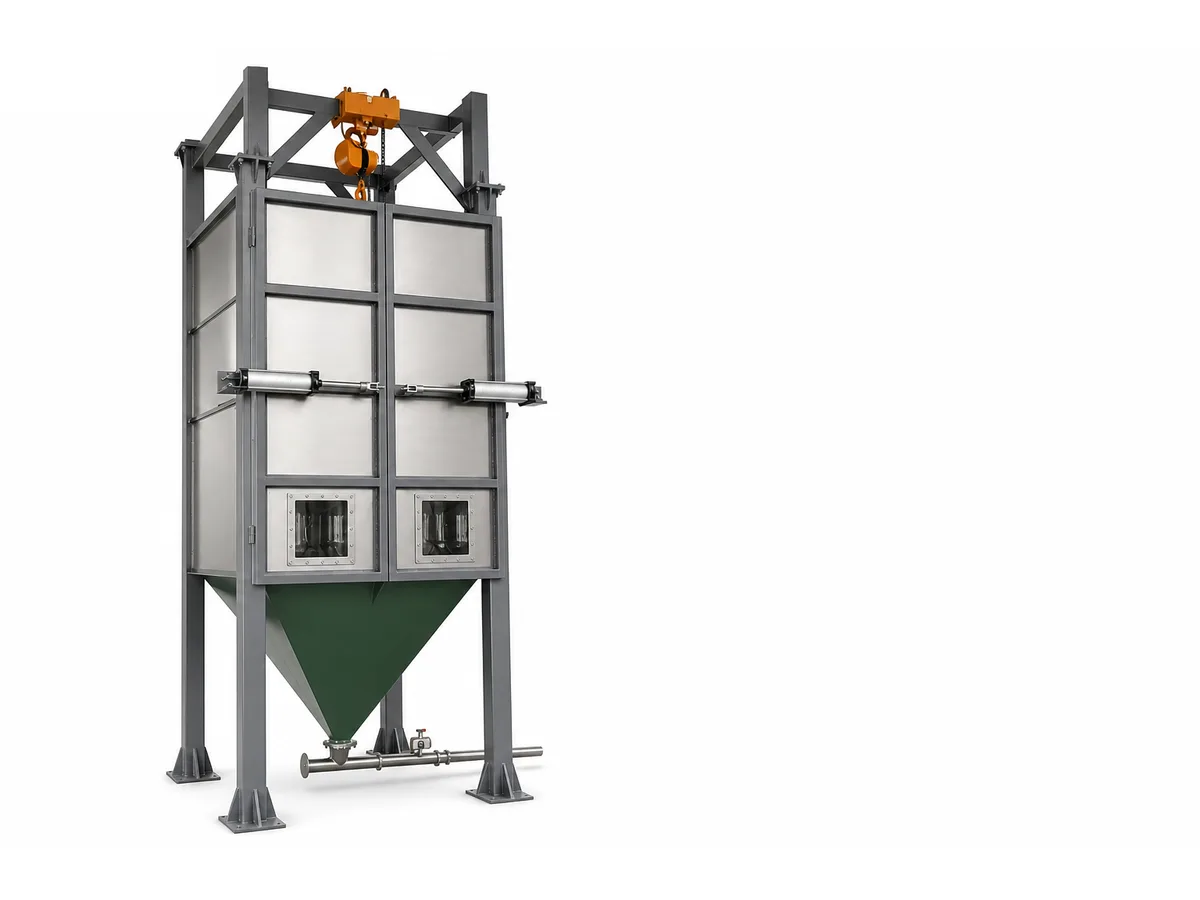
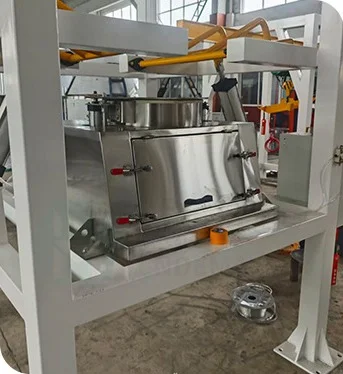
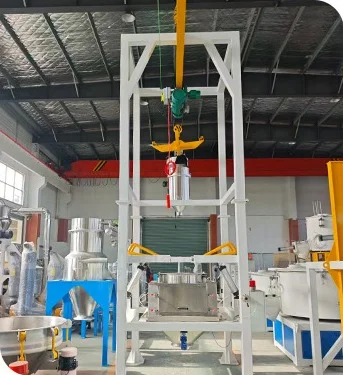
Dust-tight spout connection and massage aids improve emptying.
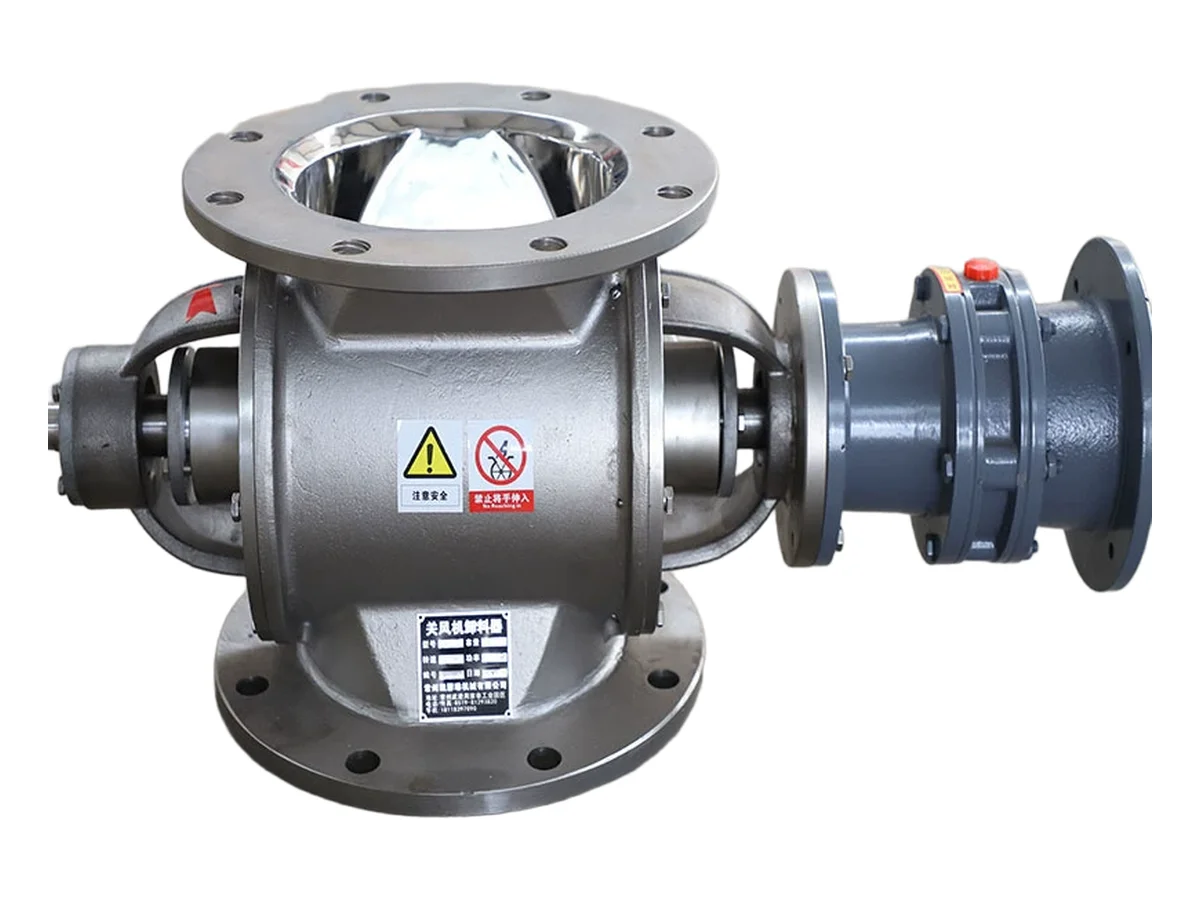
Match discharge to vacuum conveying, screw feed or rotary valves.
Poor FIBC stations create dust, bridging and downtime upstream.
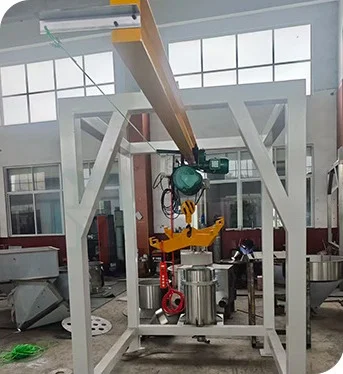
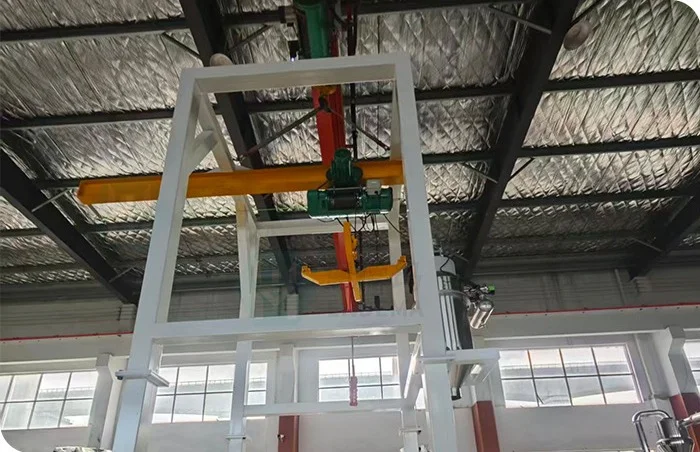
Bag dimensions and hoist travel set the frame, not the throughput.
Partial emptying is the quiet failure — repeatability beats speed.
Technical Overview
Why big bag unloading matters
Flexible intermediate bulk containers (FIBCs) are a standard way to receive powders in food, chemical, battery and pharmaceutical plants. A poorly designed discharge station leads to dust exposure, incomplete emptying, bridging and unplanned downtime at the start of the process line. The reason it deserves more attention than its position in the plant suggests is that it is the first machine in the process, so every hour it loses is an hour the whole line loses, and every thing it fails to empty is material that is paid for twice — once in the bag and once as waste. It is also the point where material arrives in the least controlled condition it will ever be in: a bag of unknown internal state, delivered by a vehicle, handled by an operator.
The first machine in the line is also the one the whole line waits for
Common discharge challenges
Fine, cohesive and hygroscopic powders often bridge at the bag spout or hang up on the bag walls. Without flow aids, operators resort to manual shaking or hammering, which increases dust and slows throughput. Moisture ingress during connection also causes caking and batch inconsistency. There is a second, less visible failure that is arguably worse: partial emptying. A bag that discharges most of its contents looks like a success on the floor, but the material left in the corners is a quantity nobody recorded, and it turns into a yield discrepancy that is very hard to trace once the bag has gone. Repeatable emptying matters as much as fast emptying, and both come from the connection and the flow aids rather than from the valve.
Partial emptying is the quiet failure: the shortfall never reaches the batch record
Key design considerations
Specify a dust-tight spout connection, integrated dust extraction and massage paddles to promote mass flow. Match downstream equipment — rotary valve, screw feeder or vacuum pickup — to the required feed rate and pressure conditions. Hoist or forklift loading should align with your warehouse layout and bag loop type. Beyond the checklist, the design principle is that the powder should travel a straight, short, downward path from the bag to the process, with as few changes of direction as the layout allows. Every additional valve, bend or intermediate hopper is a place where material can hang up, dust can escape and a future operator can be blamed for a problem that was designed in.
A short, straight, downward path leaves the fewest places for powder to hang up
Sizing the frame and the hoist
The station's dimensions are set by the bag and the vehicle that delivers it, not by the powder. Establish the FIBC size and loop type first, because four-loop, single-loop and stevedore-loop bags need different lifting arrangements; then the bag weight, which for FIBCs commonly falls between about 0.1 and 2 tonnes and determines both the hoist capacity and its safety factor. Headroom is the constraint that catches people out: the frame must clear the bag length when suspended, plus the hoist body at the top of its travel, plus enough room for an operator to attach the loops safely rather than at arm's length. Frame footprint follows the bag rather than the throughput, and throughput itself is modest by industrial standards — a typical station manages in the region of six to twelve bags an hour, limited by how fast a bag can be changed rather than by the valve underneath it.
Bag dimensions and hoist travel set the frame, not the required throughput
Dust control at the spout
Almost all the dust released by a big bag station comes from one moment: connecting and disconnecting the spout. A dust-tight spout clamp seals the bag neck to the station before the tie is opened, so the powder never meets open air, and a vent filter or an extraction connection at the discharge head takes the air displaced as the bag empties. This is the single feature worth insisting on, because a station without it will dust the room at every bag change no matter how well the rest of the line is sealed. Models are offered both with and without extraction, and where the plant already has a central collector the station can be ducted into it instead of carrying its own filter. If the material arrives in a lined outer bag, the liner is a second dust source and should be handled inside the same enclosure rather than pulled out and shaken.
Seal the spout before opening the tie — that moment causes most of the dust
When the powder will not flow
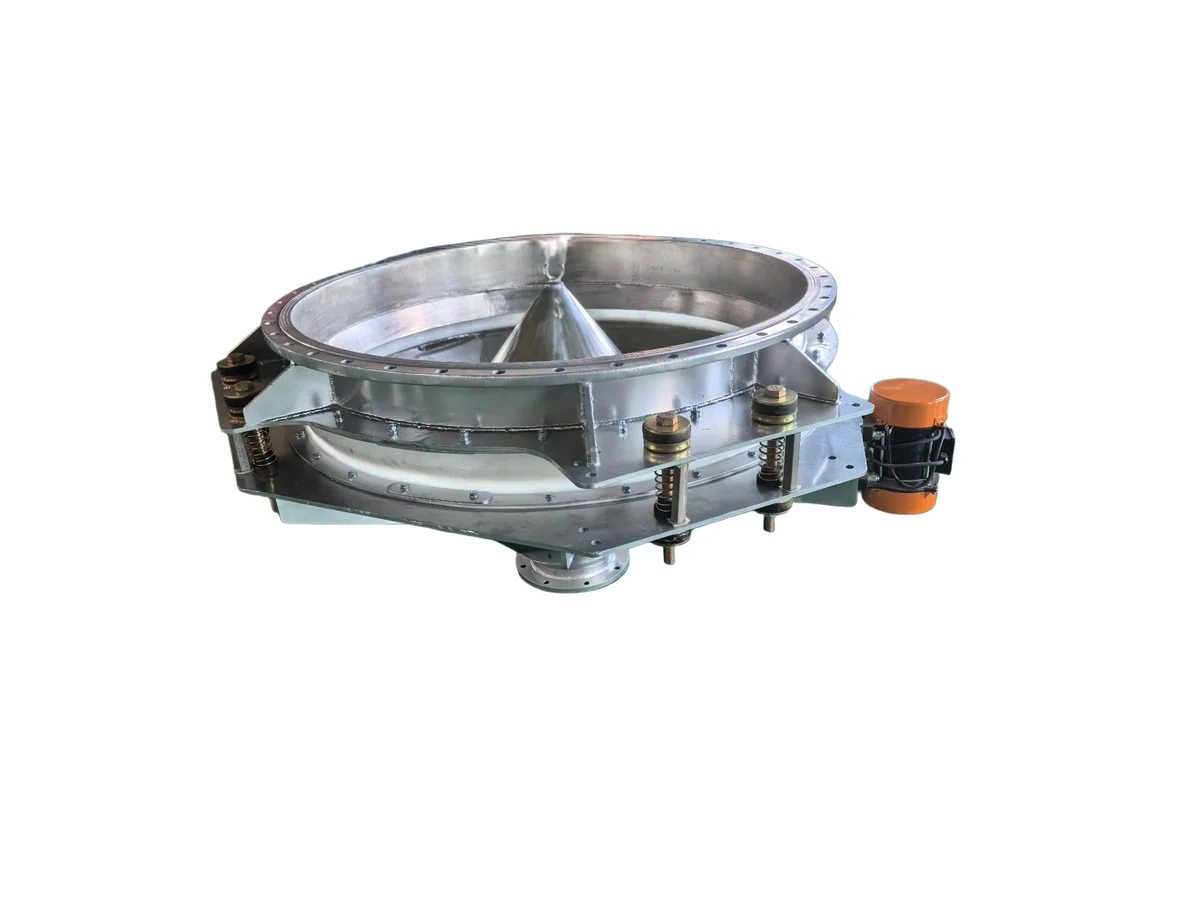
Bridging and hang-up are the complaints that make operators improvise, and improvised solutions usually mean someone striking the bag with a mallet. The mechanical answers work better and do less damage. Massage paddles or plates press rhythmically against the bag walls and restore flow to cohesive material without shock loads on the frame. A vibration motor or pneumatic vibrator can help a material that is merely sluggish, although on a very fine cohesive powder vibration tends to compact rather than release, which is why the choice should follow the powder and not the catalogue. Where the problem persists below the bag, an activation hopper with a slow agitator directly under the discharge keeps material moving to the outlet without shearing it. If lumps are arriving instead of powder, a lump breaker at the outlet solves the immediate symptom — but the more useful question is where those lumps were formed.
Massage plates for cohesion, an activation hopper for what will not release
Big bag or container unloading?
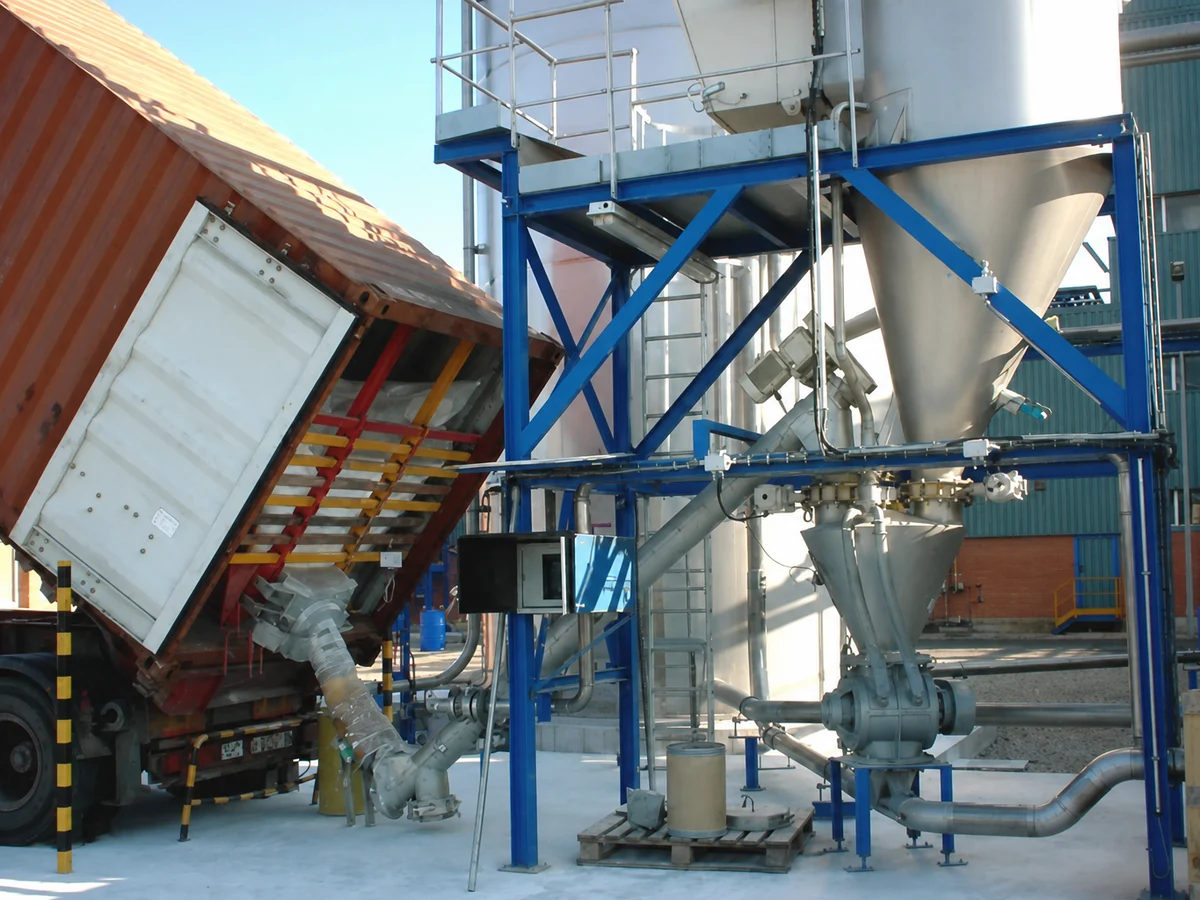
Not every bulk delivery arrives in an FIBC. Where material comes in rigid containers, an above-ground container unloading system avoids the pit a conventional tipping station would need, and the same conveying equipment serves both cases. The capacity gap is worth noting when planning: a big bag station is limited by how fast bags can be changed, while a container unloading system can be specified for substantially higher rates. The routing also differs, because the vertical lift available from a container system makes it practical to discharge directly to a silo roof or a distant mixer without an intermediate transfer. That matters more than it sounds — every time powder is handed from one device to the next is an opportunity for dust, segregation and contamination, and reducing the number of handovers is usually cheaper than controlling each one.
Container systems avoid the pit and reach higher rates than bag-by-bag unloading
Integration with conveying systems
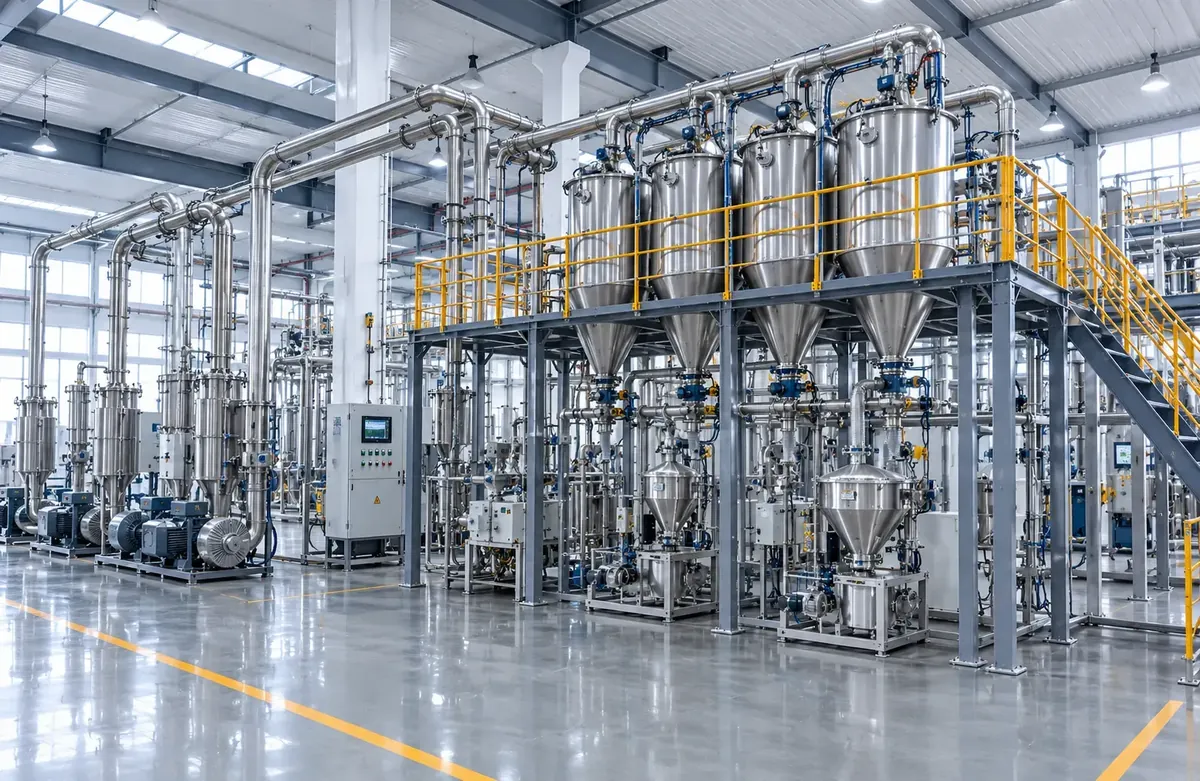
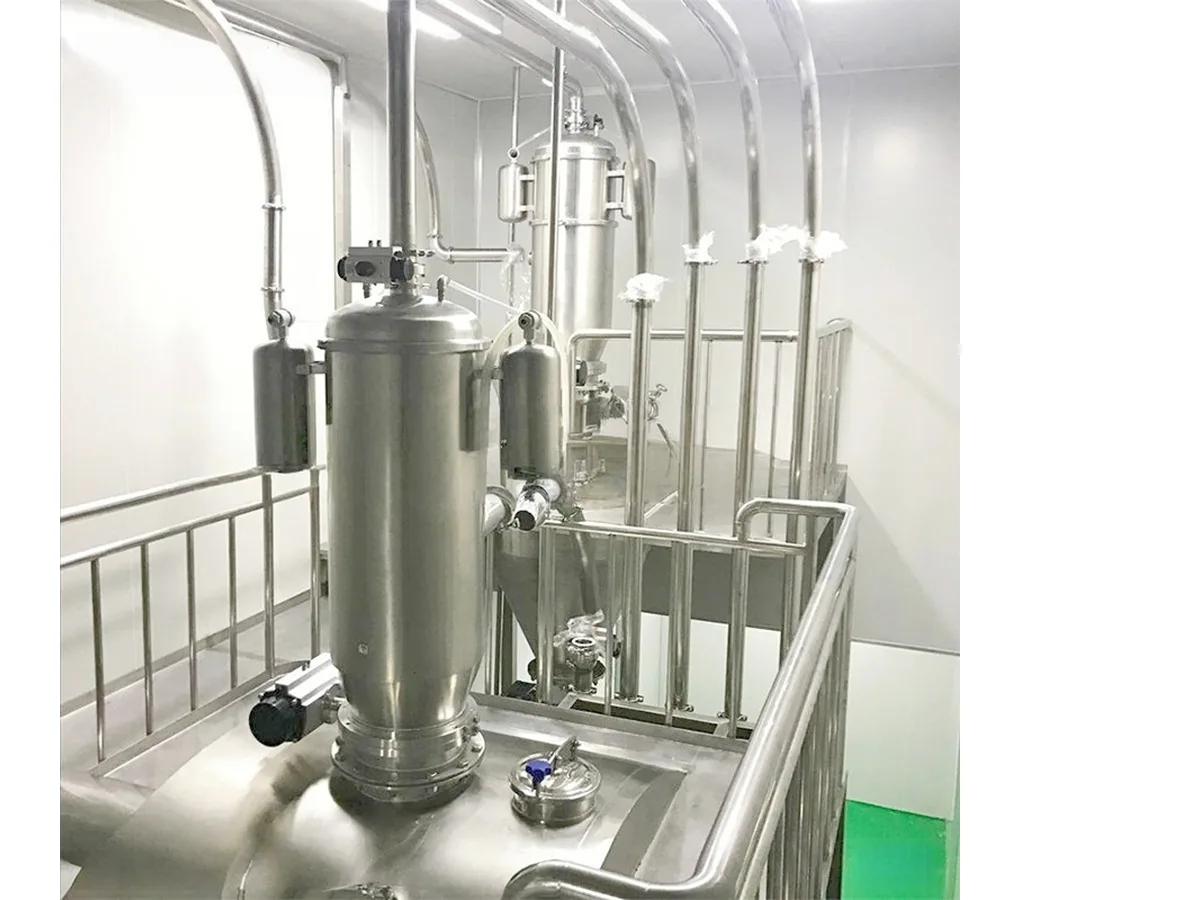
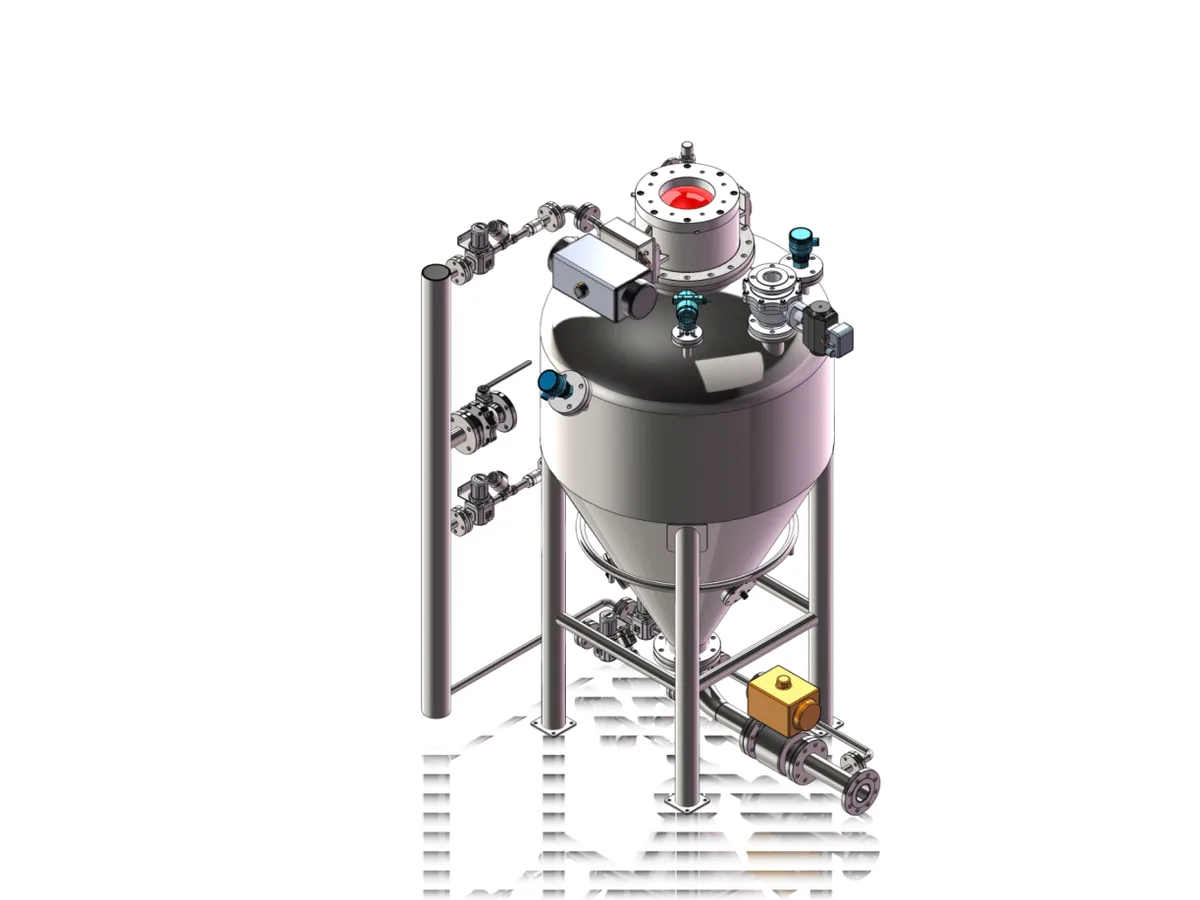
Discharge stations work best when coupled directly to vacuum conveying, pneumatic transfer or loss-in-weight feeding. This keeps the material enclosed from bag to process point, reduces manual handling and supports recipe traceability in automatic batching lines. The interface to design carefully is the discharge device, because it sits between two systems that each have their own idea of how fast material should move. A station that can deliver faster than the conveying line can accept will block; one that delivers slower will starve the process. Adding level control in the receiving hopper, and letting it start and stop the discharge rather than running both devices at fixed rates, removes most of the coordination problems before they appear.
Let the receiving hopper's level control pace the discharge, not a fixed rate
What to prepare before requesting a quotation
Stations are sized from the bag, the powder and the building, so a proposal needs all three. Provide the FIBC dimensions, loop type and maximum weight, and the loading method — forklift, overhead crane, or a hoist supplied with the station. Describe the powder: bulk density, particle size, whether it is cohesive, hygroscopic or abrasive, and whether it tends to bridge in the bag. Then give the process data: the rate in bags per hour the downstream equipment actually needs, the destination equipment and its feed arrangement, and the available headroom and floor area. Finally, state the environment — whether the area is washed down, the dust explosion classification, and whether extraction should be local to the station or ducted to a central collector.
Bag dimensions, powder behaviour and headroom together define the station
Process Flow
Typical steps covered in this article.
Bag Loading
Spout Connection
Flow Aid Discharge
Downstream Transfer
Typical Applications
Food ingredients
Chemical resins
Battery materials
Pharma excipients
Equipment
Related Products
Explore equipment commonly used with the processes described in this article.