Fluidizing Air Pads: Layout and Air Supply Selection
Where to place fluidizing air pads, what air pressure and quality they need, and how to avoid channeling, blinding and the over-aeration that ruins downstream feeding.
Over-aeration lowers bulk density and can starve a downstream screw or flood a packer.
Air introduced into the bin has to escape — the silo vent must be sized for the added volume.
Technical Overview
What an air pad does to the powder
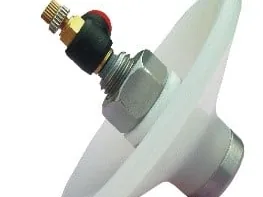
A fluidizing air pad — also sold as a bin fluidizer, aeration pad or flow-aid disc — is a shallow chamber bolted or screwed to the inside of a hopper cone, with a porous face turned towards the powder. Compressed air enters the chamber behind the face and diffuses uniformly through the media rather than jetting through it. The result is a low-velocity, evenly distributed field of air moving into the interstitial spaces between particles. That air does not need to fully fluidise the powder; it only needs to increase the separation between particles enough to cut internal friction and reduce the wall friction where the powder meets the cone. Once the bulk dilates slightly, its unconfined yield strength falls sharply, and a bed that would otherwise hold an arch begins to flow.
Is your powder even a candidate
Aeration is a material-specific solution, and applying it to the wrong powder is worse than doing nothing. Fine powders with a substantial fraction below about 75 µm are good candidates because they retain air and respond to small injections. Very fine powders below roughly 10 µm behave differently: they are slow to settle, but once settled they are difficult to re-fluidise and tend to channel, so air simply cuts a path through them instead of loosening the mass. Coarse, fast-de-aerating materials above roughly 200 µm are also poor candidates — the air escapes before it can do useful work. Wet or sticky powders should not be aerated at all: moisture plus air produces irreversible compaction and rat-holing. When in doubt, permeability and de-aeration testing on the actual material settles the question in a morning.
How many pads, and where
The critical region for discharge is not the whole cone; it is the zone immediately above the outlet, because that is where the span is narrowest and where stoppages form. Clearing that region is equivalent to giving the bin a larger effective opening, and the material above will usually follow. In practice, pads are installed in one or more horizontal rings around the cone, spaced symmetrically, with the lowest ring closest to the outlet. As a starting point, one pad per roughly 1.5 to 2 metres of cone circumference gives adequate coverage, with larger silos using two or three rings. Back-plate diameter is matched to cone size — smaller discs for small hoppers, larger for main silos. Asymmetric layouts are a common source of trouble: material fluidises on one side, slumps unevenly and the shell sees an unbalanced load.
Air supply: pressure, quality and control
The air behind the pad face should be regulated, not taken straight off the plant main. Typical working pressure is low — a fraction of a bar — and exceeding the media's rated limit will rupture it. A filter-regulator set to the low end of the range, plus a solenoid valve for automatic duty, is standard. Air quality matters as much as pressure: the supply must be clean, dry and oil-free, because oil mist and water are the two most common causes of premature media failure. Many plants add a dedicated dryer or a point-of-use filter for this reason alone. Control strategy also matters. Continuous low-rate injection during storage inhibits time consolidation and suits powders that otherwise gain strength while standing; intermittent higher-rate injection, timed with the discharge valve, suits powders that are fine in storage but reluctant to start moving.
Failure modes to design around
Three problems account for most air pad complaints. Channeling is the first: if the media permits localised flow rather than uniform diffusion, or if pressure is too high, air cuts a channel to the surface and the bulk above never sees it. Maintaining a large pressure drop across the media is what forces uniform distribution. Blinding is the second, and it is almost always an air quality or temperature problem — oil, water or exceeding the media's temperature limit. The third is over-aeration, which is a process problem rather than an equipment one. A powder that has been thoroughly aerated has a lower bulk density, so a downstream screw conveyor delivers less mass per revolution and a packing machine fills by volume rather than by weight. Batch times stretch and net weights drift.
Integration: venting, structure and cleaning
Air put into the bin has to come out. Every cubic metre injected during discharge is an extra cubic metre that the silo vent filter and the vacuum relief device must pass, and a vent sized only for the filling rate will pressurise the silo once aeration is running. This is worth checking explicitly at design stage. Structurally, the pads are light and require only a cut opening and a gasket, so retrofitting is straightforward, but the cone wall must be thick enough to carry the fixing and the opening should be de-burred so the gasket seats.
Choosing pads over the alternatives
Air pads compete with vibrators, mechanical agitators and air cannons. Against vibration, pads have the advantage that they do not compact the material and do not fatigue the shell — a decisive point on thin-walled or concrete silos, and on any powder that gets denser when shaken. Against mechanical agitation, pads are far cheaper, have no moving parts inside the bin and cannot damage fragile particles, but they cannot handle wet, cohesive or fibrous materials. Against air cannons, pads give gentler, more continuous action without shock loading the structure. The usual outcome is not a straight substitution: pads handle maintenance of flow in storage and the start of discharge, while a mechanical device deals with material that has already set hard.