Mixing
Air Jet Mill
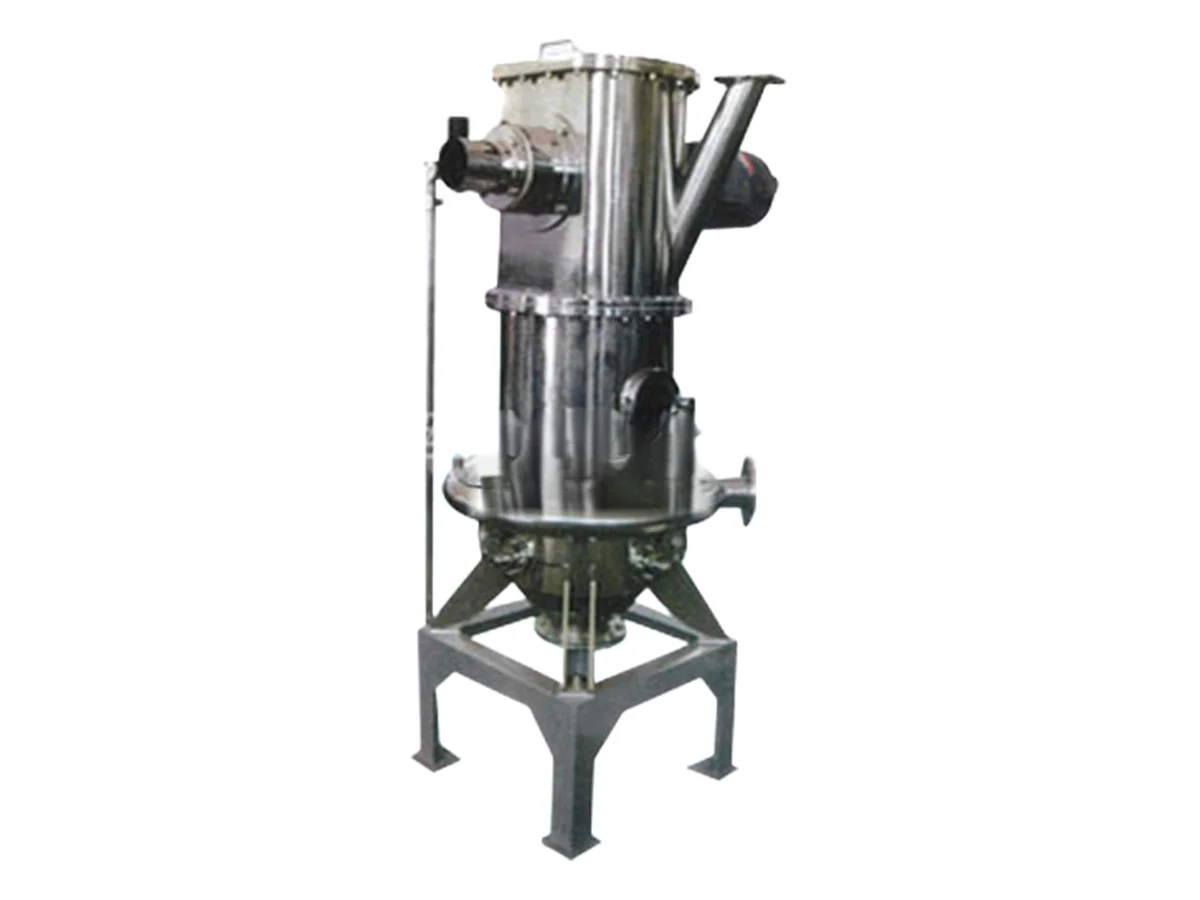
CYprocess air jet mills — also called fluid-energy mills or jet pulverisers — reduce particle size by high-velocity particle collision using compressed air or nitrogen. With no mechanical grinding media, metal contamination is limited and narrow fine fractions can be produced.
Shanghai-built. Drawings come with the quotation, and material certificates are available on request. Factory and documents
1 / 3
Overview
About Air Jet Mill
How this equipment works in powder handling lines and what to consider when selecting it.
Working principle
Material is accelerated in high-velocity gas jets so that particles collide with one another and break. There is no rotor or grinding media in the milling zone, so product contacts only the liner and the gas stream. An integrated classifier returns oversize particles to the milling zone and releases only the target fraction.
Options and integration
Nitrogen operation is used for oxidation-sensitive or combustible powders, and wear-resistant liners are specified for abrasive products. Feed is metered in through a screw, rotary valve or vacuum line, and milled product is collected in a cyclone followed by a filter receiver.
Where it fits in the process
Features
Key Features
Design points that make the Air Jet Mill practical for industrial powder plants.
Specifications
Typical Specifications
Final sizing depends on material properties, capacity and plant layout. Request a project review for a tailored proposal.
Model range
| Model | Feed size | Final fineness | Capacity (kg/h) | Compressor power (kW) |
|---|---|---|---|---|
| CY-JM-40 | < 5 mm | 3 - 200 µm | 10 - 50 | 22 |
| CY-JM-60 | < 5 mm | 3 - 200 µm | 30 - 300 | 45 |
| CY-JM-80 | < 5 mm | 3 - 200 µm | 200 - 1000 | 88 |
| CY-JM-100 | < 5 mm | 3 - 200 µm | 600 - 2000 | 145 |
| CY-JM-120 | < 5 mm | 3 - 200 µm | 1500 - 3000 | 200 |
| CY-JM-140 | < 5 mm | 3 - 200 µm | 4000 - 5000 | 360 |
CY-JM fluidised-bed jet mills — grinding by compressed air only, no moving grinding parts. Capacities are indicative for medium-hardness powders with the target fineness mid-range; compressor power is the supply requirement at the listed rate. Original FSJ-type table corrected for typos (1500-303 / 4000-304 → 1500-3000 / 4000-5000).
General specifications
| Principle | Fluid-energy / jet collision milling |
|---|---|
| Gas | Compressed air or nitrogen |
| Fineness | Application-dependent D50 target |
| Classification | Integrated or external classifier |
| Liner | Wear-resistant options for abrasive products |
| Feed | Screw / vacuum / rotary valve |
| Collection | Cyclone plus filter receiver |
Materials
Suitable Materials
Powder and granule categories typically specified with a air jet mill. Suitability is confirmed per project from bulk density, particle size, moisture and process conditions.
Battery materials
cathode and anode precursors, conductive carbon
Pigments & dyes
organic and inorganic pigments, toners
Pharmaceutical solids
API, excipients, fine-chemical actives
Minerals & fillers
talc, mica, calcium carbonate, alumina
Ceramics & abrasives
ceramic frits, alumina, silicon carbide
Specialty chemicals
heat-sensitive and oxidation-sensitive powders
Not sure whether your material will convey? Send us a sample description and we will confirm before quotation.
Applications
Process Applications
Process points where this equipment is typically installed, from bulk intake through to packing.
Downloads
Catalogs & Datasheets
Technical documents related to this product and our powder handling range.
FAQ
Air Jet Mill FAQ
Common questions about selection, integration and quotation.
There is no rotor or grinding media in the milling zone, so the main sources of metal contamination are removed and less heat reaches the product. That makes jet milling the usual choice for high-purity, heat-sensitive or contamination-critical powders.
System partners
Related Products
Equipment commonly paired with Air Jet Mill in complete powder handling lines.
Engineering support
Enquire about Air Jet Mill
Share your material, capacity and plant layout. Our engineers will confirm sizing and send a tailored proposal.